2026: The Year of Humanity in the Age of AI
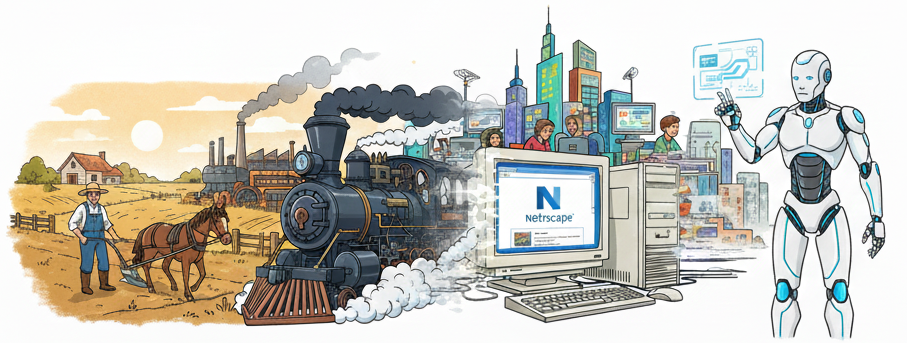
Welcome to 2026! A decade or more from now, we’ll look back at 2026 as the year that cemented the foundation blocks for the new era for humankind. The industrial revolution started in 1760, but Adam Smith’s “Wealth of Nations,” published in 1776, is what gave humanity the framework to think about what was happening, and how to accelerate progress. Similarly, the Information Age started in 1947 with the invention of the transistor, but it wasn’t until 1995, with the Netscape IPO and Windows 95, that really propelled tech adoption.
I hate to write my predictions so they can’t come back to haunt me, but I believe 2026 will be the 1995 of the AI era.
Humanity vs. Artificiality
Since OpenAI awed the world with the launch of ChatGPT in November 2022, we have been on this journey of what is appropriate or not for an AI to do (or to be). On one end of the spectrum, you have your AI maximalists, who believe AI should be everywhere and the purpose of humanity is to serve AI (sprinkle a transhumanism in there). On the other end, you have the AI-deniers who believe we must shut down the AI data centers and stop investing in this technology. Neither matters much, and I advise you to tune out those comments.
This moment lies in defining what it means to be human in the age of AI.
For thousands of years, only humans could perform certain tasks such as summarizing a book, writing poetry, answering a customer support call, or driving a car. Now that AI can do those things—and it’ll only get better—(em-dashes written by me), what’s the point of being a human?
Before the industrial revolution, with few exceptions, most humans lived for subsistence. They produced what they needed to live, or what their village/town needed. With the industrial revolution, we discovered that specialization and production-lines (even in farming) were a scalable and efficient means of running a society. Finally, the information revolution created layers of handling knowledge and data to benefit the layer underneath. And we’ve been piling on these layers for over a century.
AI will slowly dismantle those layers. AI will also dismantle the industrial revolution with self-driving cars, robots in factories, autonomous drones, and even farming. We are not far from having a farm fully managed and operated by a single individual behind a screen who’ll never touch the seeds, the ground, or a fertilizer.
Making meaning and living in societies
As I pored through a long list of definitions of “humanity” from philosophers and scientists, I found only three definitions that withstand the AI era:
1) Self-awareness (Descartes) — consciousness of our own existence. 2) Social-relational (Aristotle/Buber) — we exist in a relationship and our identities are formed through others. 3) Labor-purpose (Marx/Frankl) — We find meaning through work and contribution.
Although Descartes’ definitions of consciousness and existence make for a great midnight dorm-hallway conversation, I don’t think they bring any practical value to the human-machine relationship in the AI era. Frontier AI researchers love to have these debates, but it brings little to no practical application to our lives.
The other two are phenomenal and practical.
Aristotle declared that humans can’t fully realize themselves without a community. Martin Buber extended this idea by going one step further and saying that a person isn’t a solo project but emerges through relation. Regardless of your feelings about Marx, he stated that what makes us human is our conscious productive activity. In other words, we are what we do! Which is parallel to Viktor Frankl, a Holocaust survivor’s, belief that our motivation comes from seeking meaning.
Community
The community will take (back) the centerpiece of our society, starting in 2026. Over the last few decades, and particularly over the last 15 years, mobile devices and social networks have connected the world. Yet, it drove us farther apart. Dating apps went from a fringe tool to widespread adoption, and now they are collapsing. They didn’t deliver the authentic connection humans seek. Social media has made it ever easier to share ideas and learn from others, and now they are dominated by bots and rage bait. Digital services that were meant to connect the world, divided it. Third-spaces are a declining phenomenon, even in countries where the cultural norms are built around multi-generational social groups.
The data about friendship, dating, loneliness, and helplessness are quite bleak(1). This has led to peak depression and anxiety diagnostics, particularly for those born after 1990. They don’t know a world without the Internet. As a society, we dug ourselves a hole. We either hit bottom or are close to it. Why 2026?
Change is super hard. For the last three years, AI has taken people for a spin, in their personal and professional lives. Healthcare, education, finance, work, customer support, and other areas are changing. This will continue for the next few years, but we are already seeing some “stabilization.” LLMs are becoming faster, better, and cheaper, but they are still doing the same job they were doing a year ago. We are seeing new products built on top of a stable(-ish) foundation. Even though things are still changing fast, we have a predictable pace of change, and the fog of the future is clearing. That stability will help us to see AI for what it is—instead of fearing it—and also allow us to focus on the other side, the human.
We have an unresolved issue with work. People suggest that universal basic income (UBI) and the “age of abundance” will address the shortage of work opportunities. From an economic point of view, if UBI and abundance exist, that would be enough. However, it doesn’t give people purpose. Regardless of money, we need work that makes us feel seen, skilled, and valued(2). I have yet to see an answer to this unaddressed problem. Every proposal so far feels idealistic, impractical, or denialist. It’s a severe problem in the US with its weak labor laws and non-existent social safety nets. In 2026, we’ll see a burst of ideas and initiatives to bring people together to create genuine connections. Apps that organize group dinners with strangers, a resurgence of running clubs, people (even men!) being vulnerable on social media seeking others for activities, etc. Not a swipe left/right, not a faceless post on Reddit, not a coworker behind a screen. We’ll see a desire to build things together and in-person; a multitude of events around music, hobbies, and shared interests; and a rebirth of flirting and approaching people when you are out-and-about. These won’t happen by the end of the year. As I said at the beginning of this article, a decade from now, we’ll look back at this moment and say, “That’s when it started.”
AI won’t take our humanity because our humanity is about other humans. It’ll reinforce it.
===
(1) Book: Together: The Healing Power of Human Connection in a Sometimes Lonely World by Vivek H. Murthy, MD
(2) Quote from Matt Shobe