The Innovator and the Founder
People use the terms innovator and founder interchangeably in conversations, social media posts, and in articles. That’s fine most of the time. It becomes a problem when startup founders or investors don’t get the distinction. It causes them to make the wrong bets on themselves and on others.
The tl;dr is that a founder is the person who creates a company from nothing. An innovator is someone who invents something new.
I’m not the first person to make this distinction. In 2018, Steve Blank wrote a brief article titled The Difference Between Innovators and Entrepreneurs. [Side-note: Steve, I’ll redesign and rebuild your website for free!] He doesn’t elaborate much beyond calling out that they are distinct and focusing on defining what an entrepreneur is.
These are not a spectrum or traits. They are two orthogonal skills.
The innovator is someone who converts an insight into something novel. A distinct new product, a fresh approach, a new angle on an old problem. Innovators exist everywhere. They are in startups, big companies, academia, and even in government.
The founder is someone who makes things happen from scratch. They build the organization, capitalize the business, ship the product, close the deals, and ultimately create a viable business.
And because these are skills, they can be developed. But here’s the practical reality: by the time most people start their first company, they are already leaning strongly in one direction. Changing that takes deliberate effort over years. And it’s nearly impossible if you don’t even recognize where you stand.
Innovator X Founder
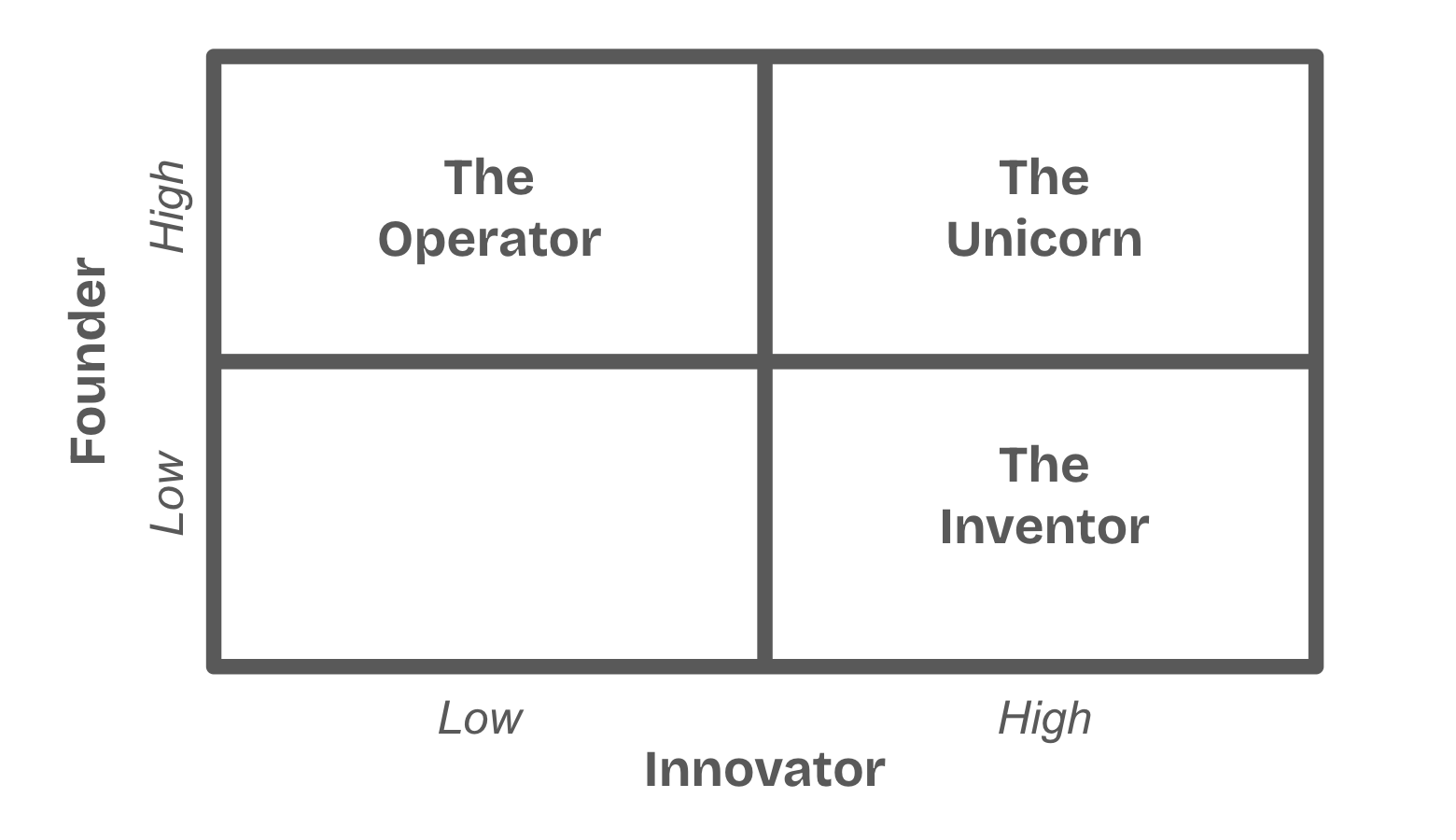
Let’s talk about the three quadrants that matter to this article.
In the high-founder, low-innovator (top-left) quadrant, it’s where most people starting businesses exist. It’s not even close. They represent 99 out of 100 folks who start a business. Everything from a restaurant owner to a retail operator, from someone who opens a marketing agency to the person who launches a tech consultancy. It also includes most startup founders. They are creating a new product, but it’s not necessarily novel. It’s the same thing in a different color or for a slightly different market.
In the high-innovator, low-founder (bottom-right) you have the brilliant inventor who can’t build an org. They tell stories about their innovation that makes people’s brains get a jolt of dopamine. They will captivate the audience when they go on stage and talk about their new thing.
In the high-innovator, high-founder, which is only 1 in 100,000 people, you have a rare combination of both. These are the people who build companies that will become massive public companies, and we will write biographical books about them.
The Three Quadrants
Let’s expand on the high-founder, low-innovator, which represents the vast majority of people who start companies. I’ve been around startups long enough to hear the same pitches over and over. It’s not unusual for me to hear similar startup pitches in the same week! That’s the sure-fire way to identify this type of person. It doesn’t mean they won’t be able to build successful businesses. If they are good founders, they will plow through and capture an underserved market. Who cares if the solution is not innovative?
The innovator-starter is more complicated. They created something new, and possibly valuable to the customer, but it takes a lot more to build a business. Having a great new idea is table stakes. You still need to hire, sell, manage cash, deal with customers who don’t care how clever your approach is, and make a hundred unglamorous decisions a day. Many innovators who start companies get stuck right here. They can’t close a deal, retain an employee, or ship on a deadline. In the tech startup world, this seems to account for three out of five venture-backed companies. They push the boundaries of what’s possible but struggle to convert that into real, sustainable value.
Then there’s the rare one. The person who is both a high-innovator and a high-founder. Chipotle’s founders rethought how fast food could work and then built a machine that scaled it to thousands of locations. The Collison brothers at Stripe reimagined online payments from scratch and then obsessively built a company around craftsmanship, customer feedback, and operational rigor. That combination of genuine novelty and relentless execution separates a massive outcome from a good business. It’s that rare combination of invention meeting demand meeting operational instinct.
Two Hypotheses
Here’s where I’ll stake my claims:
You can’t create something big without innovation. Execution alone can get you a solid business. A profitable one, even. But it won’t get you a category-defining company. The people who build something truly large always bring a novel insight to the table. A different way of seeing the market, the customer, or the technology. Without that, you’re competing on margins and efficiency against everyone else doing similar things.
Innovation alone is a reliable path to failure. This is the hard truth that the tech world doesn’t talk about enough. A breakthrough idea with no one to operationalize it is just a demo. The graveyard of startups is full of brilliant innovations that never found product-market fit, never built a sales motion, never figured out how to hire and retain. If all you have is insight or a product, you don’t have a business.
The Status Game
Here’s where it gets uncomfortable. Society doesn’t value these two labels equally. “Founder” earns you credibility. People trust that you can get things done. “Innovator” earns you admiration. People think you’re brilliant. And admiration wins in our culture. Every time.
You see this play out when co-founders split after a successful company. The fight is always over who was the real innovator. Nobody argues about who was better at operations. Nobody claims, “I was the one who made payroll work and kept the servers running.” They claim the idea. The vision. The breakthrough. That tells you everything about which label people actually want.
This creates a weird incentive problem. Founders rebrand themselves as innovators to gain admiration. Innovators call themselves founders to gain credibility. Both end up chasing a label that doesn’t match their actual strengths, and they make worse decisions because of it.
The Self-Awareness Gap
The most dangerous version of this plays out in second startups. Someone succeeds the first time around, often because they had a co-founder or early team member who excelled in complementary ways. The innovator had a great operator beside them, or the operator had someone who provided the novel insight. The combination worked.
Then they leave to do it again. Solo, or with a mismatched partner. And they fail. Not because they got worse, but because they never understood why they succeeded in the first place. They attributed the outcome to their own skills when it was actually the combination that made it work.
I’ve watched this happen more times than I can count. It’s one of the most predictable patterns in startups, and it’s almost entirely a self-awareness problem.
Remember, these are skills. They can be developed. But development requires knowing what you need to develop. The person who thinks they succeeded because of their innovation will double down on innovation next time. They won’t invest in learning how to operate, hire, or sell. And the cycle repeats.
The VC Bridge
Venture capital, to an extent, solves this gap. When a VC funds an innovator, they’re not just betting on the idea. They’re betting that the innovator can use that money to hire people with complementary skills (operators, salespeople, finance leaders) who can turn the innovation into a functioning business.
This is why many VCs ask themselves a simple question: Would I want to work for this person? It sounds like a gut-check, but it’s actually a proxy for something specific. Can this person attract the talent that fills their gaps? If the innovator can recruit a great COO, a great VP of Sales, or a great head of engineering, then the missing founder skills can be “acquired” through the team. If they can’t, all the funding in the world won’t fix the problem.
Know Which One You Are
The point of this article isn’t to say one is better than the other. It’s that they’re different, and knowing where you stand matters more than most people think.
If you lean founder, own it. Build a great business on solid execution. Don’t pretend you need to be an innovator to be successful. Most successful businesses aren’t innovative, and that’s fine. Alternatively, find an innovator to work side-by-side with.
If you lean innovator, be honest about what you’re not. Find the people who complement you. Don’t assume that having a great idea means you can build a company. Or invest the years it takes to develop those skills, knowing it won’t come naturally.
And if you’re lucky enough to be both. Well, you wouldn’t be reading this article. Sorry.