<?xml version="1.0" encoding="utf-8"?><feed xmlns="http://www.w3.org/2005/Atom" ><generator uri="https://jekyllrb.com/" version="4.3.4">Jekyll</generator><link href="https://calbucci.com/feed.xml" rel="self" type="application/atom+xml" /><link href="https://calbucci.com/" rel="alternate" type="text/html" /><updated>2026-03-20T14:47:42+00:00</updated><id>https://calbucci.com/feed.xml</id><title type="html">Marcelo Calbucci</title><subtitle>Marcelo Calbucci | Founder, Author, Tech/Prod, Community Builder</subtitle><author><name>Marcelo Calbucci</name></author><entry><title type="html">The Innovator and the Founder</title><link href="https://calbucci.com/2026-03-19-innovators-founders" rel="alternate" type="text/html" title="The Innovator and the Founder" /><published>2026-03-19T00:00:00+00:00</published><updated>2026-03-19T00:00:00+00:00</updated><id>https://calbucci.com/innovators-founders</id><content type="html" xml:base="https://calbucci.com/2026-03-19-innovators-founders"><![CDATA[<p><img src="/assets/images/innovators.jpg" alt="image" /></p>

<p>People use the terms innovator and founder interchangeably in conversations, social media posts, and in articles. That’s fine most of the time. It becomes a problem when startup founders or investors don’t get the distinction. It causes them to make the wrong bets on themselves and on others.</p>

<p>The tl;dr is that a founder is the person who creates a company from nothing. An innovator is someone who invents something new.</p>

<p>I’m not the first person to make this distinction. In 2018, Steve Blank wrote a brief article titled <a href="https://steveblank.com/2018/04/03/the-difference-between-innovators-and-entrepreneurs/">The Difference Between Innovators and Entrepreneurs</a>. [Side-note: Steve, I’ll redesign and rebuild your website for free!] He doesn’t elaborate much beyond calling out that they are distinct and focusing on defining what an entrepreneur is.</p>

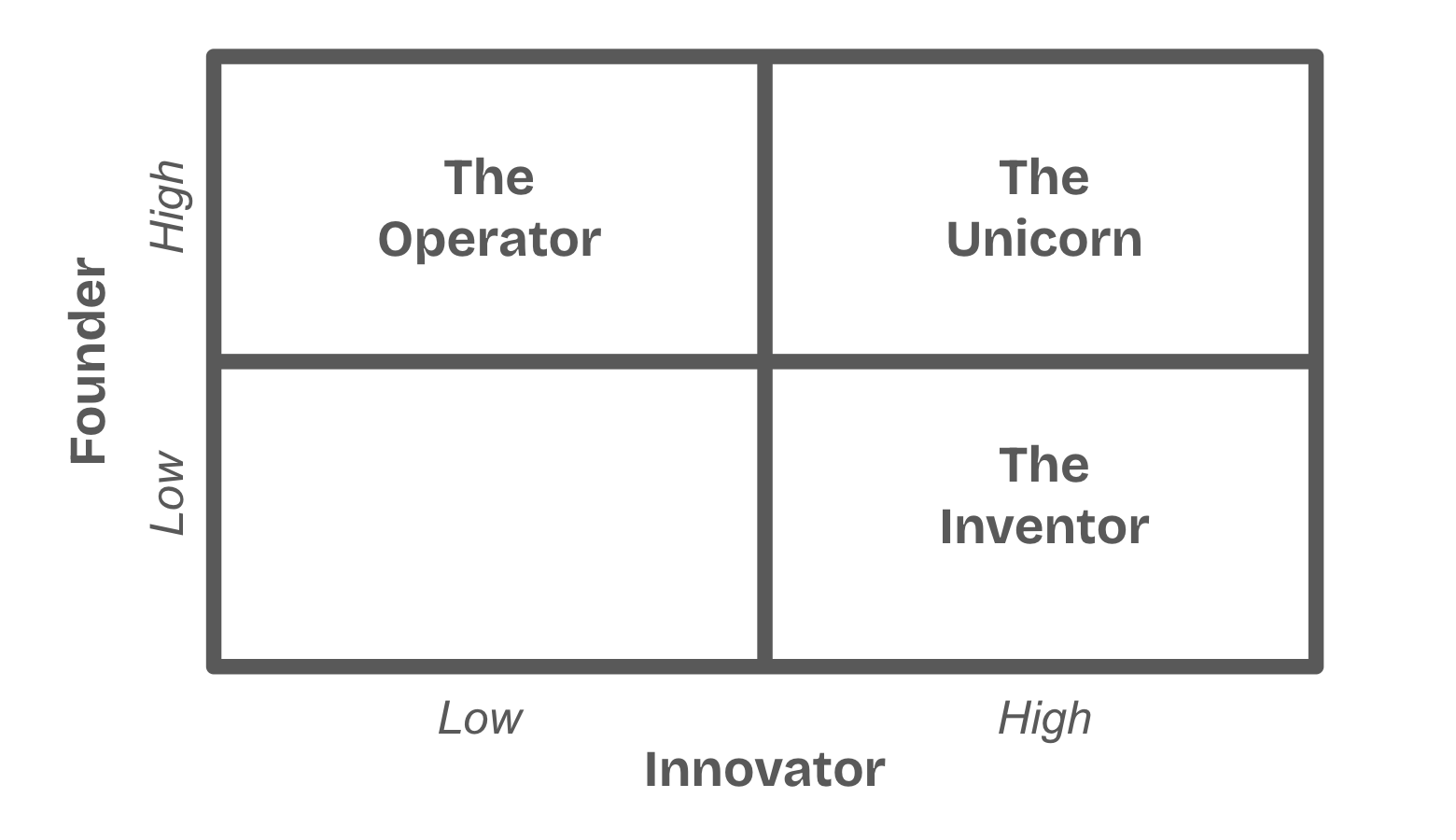
<p>These are not a spectrum or traits. They are two orthogonal skills.</p>

<p>The innovator is someone who converts an insight into something novel. A distinct new product, a fresh approach, a new angle on an old problem. Innovators exist everywhere. They are in startups, big companies, academia, and even in government.</p>

<p>The founder is someone who makes things happen from scratch. They build the organization, capitalize the business, ship the product, close the deals, and ultimately create a viable business.</p>

<p>And because these are skills, they can be developed. But here’s the practical reality: by the time most people start their first company, they are already leaning strongly in one direction. Changing that takes deliberate effort over years. And it’s nearly impossible if you don’t even recognize where you stand.</p>

<h2 id="innovator-x-founder">Innovator X Founder</h2>

<p><img src="/assets/images/innovator-founder-quadrants.png" alt="image" /></p>

<p>Let’s talk about the three quadrants that matter to this article.</p>

<p>In the high-founder, low-innovator (top-left) quadrant, it’s where most people starting businesses exist. It’s not even close. They represent 99 out of 100 folks who start a business. Everything from a restaurant owner to a retail operator, from someone who opens a marketing agency to the person who launches a tech consultancy. It also includes most startup founders. They are creating a new product, but it’s not necessarily novel. It’s the same thing in a different color or for a slightly different market.</p>

<p>In the high-innovator, low-founder (bottom-right) you have the brilliant inventor who can’t build an org. They tell stories about their innovation that makes people’s brains get a jolt of dopamine. They will captivate the audience when they go on stage and talk about their new thing.</p>

<p>In the high-innovator, high-founder, which is only 1 in 100,000 people, you have a rare combination of both. These are the people who build companies that will become massive public companies, and we will write biographical books about them.</p>

<h2 id="the-three-quadrants">The Three Quadrants</h2>

<p>Let’s expand on the high-founder, low-innovator, which represents the vast majority of people who start companies. I’ve been around startups long enough to hear the same pitches over and over. It’s not unusual for me to hear similar startup pitches in the same week! That’s the sure-fire way to identify this type of person. It doesn’t mean they won’t be able to build successful businesses. If they are good founders, they will plow through and capture an underserved market. Who cares if the solution is not innovative?</p>

<p>The innovator-starter is more complicated. They created something new, and possibly valuable to the customer, but it takes a lot more to build a business. Having a great new idea is table stakes. You still need to hire, sell, manage cash, deal with customers who don’t care how clever your approach is, and make a hundred unglamorous decisions a day. Many innovators who start companies get stuck right here. They can’t close a deal, retain an employee, or ship on a deadline. In the tech startup world, this seems to account for three out of five venture-backed companies. They push the boundaries of what’s possible but struggle to convert that into real, sustainable value.</p>

<p>Then there’s the rare one. The person who is both a high-innovator and a high-founder. Chipotle’s founders rethought how fast food could work and then built a machine that scaled it to thousands of locations. The Collison brothers at Stripe reimagined online payments from scratch and then obsessively built a company around craftsmanship, customer feedback, and operational rigor. That combination of genuine novelty and relentless execution separates a massive outcome from a good business. It’s that rare combination of invention meeting demand meeting operational instinct.</p>

<h2 id="two-hypotheses">Two Hypotheses</h2>

<p>Here’s where I’ll stake my claims:</p>

<p>You can’t create something big without innovation. Execution alone can get you a solid business. A profitable one, even. But it won’t get you a category-defining company. The people who build something truly large always bring a novel insight to the table. A different way of seeing the market, the customer, or the technology. Without that, you’re competing on margins and efficiency against everyone else doing similar things.</p>

<p>Innovation alone is a reliable path to failure. This is the hard truth that the tech world doesn’t talk about enough. A breakthrough idea with no one to operationalize it is just a demo. The graveyard of startups is full of brilliant innovations that never found product-market fit, never built a sales motion, never figured out how to hire and retain. If all you have is insight or a product, you don’t have a business.</p>

<h2 id="the-status-game">The Status Game</h2>

<p>Here’s where it gets uncomfortable. Society doesn’t value these two labels equally. “Founder” earns you credibility. People trust that you can get things done. “Innovator” earns you admiration. People think you’re brilliant. And admiration wins in our culture. Every time.</p>

<p>You see this play out when co-founders split after a successful company. The fight is always over who was the real innovator. Nobody argues about who was better at operations. Nobody claims, “I was the one who made payroll work and kept the servers running.” They claim the idea. The vision. The breakthrough. That tells you everything about which label people actually want.</p>

<p>This creates a weird incentive problem. Founders rebrand themselves as innovators to gain admiration. Innovators call themselves founders to gain credibility. Both end up chasing a label that doesn’t match their actual strengths, and they make worse decisions because of it.</p>

<h2 id="the-self-awareness-gap">The Self-Awareness Gap</h2>

<p>The most dangerous version of this plays out in second startups. Someone succeeds the first time around, often because they had a co-founder or early team member who excelled in complementary ways. The innovator had a great operator beside them, or the operator had someone who provided the novel insight. The combination worked.</p>

<p>Then they leave to do it again. Solo, or with a mismatched partner. And they fail. Not because they got worse, but because they never understood why they succeeded in the first place. They attributed the outcome to their own skills when it was actually the combination that made it work.</p>

<p>I’ve watched this happen more times than I can count. It’s one of the most predictable patterns in startups, and it’s almost entirely a self-awareness problem.</p>

<p>Remember, these are skills. They can be developed. But development requires knowing what you need to develop. The person who thinks they succeeded because of their innovation will double down on innovation next time. They won’t invest in learning how to operate, hire, or sell. And the cycle repeats.</p>

<h2 id="the-vc-bridge">The VC Bridge</h2>

<p>Venture capital, to an extent, solves this gap. When a VC funds an innovator, they’re not just betting on the idea. They’re betting that the innovator can use that money to hire people with complementary skills (operators, salespeople, finance leaders) who can turn the innovation into a functioning business.</p>

<p>This is why many VCs ask themselves a simple question: Would I want to work for this person? It sounds like a gut-check, but it’s actually a proxy for something specific. Can this person attract the talent that fills their gaps? If the innovator can recruit a great COO, a great VP of Sales, or a great head of engineering, then the missing founder skills can be “acquired” through the team. If they can’t, all the funding in the world won’t fix the problem.</p>

<h2 id="know-which-one-you-are">Know Which One You Are</h2>

<p>The point of this article isn’t to say one is better than the other. It’s that they’re different, and knowing where you stand matters more than most people think.</p>

<p>If you lean founder, own it. Build a great business on solid execution. Don’t pretend you need to be an innovator to be successful. Most successful businesses aren’t innovative, and that’s fine. Alternatively, find an innovator to work side-by-side with.</p>

<p>If you lean innovator, be honest about what you’re not. Find the people who complement you. Don’t assume that having a great idea means you can build a company. Or invest the years it takes to develop those skills, knowing it won’t come naturally.</p>

<p>And if you’re lucky enough to be both. Well, you wouldn’t be reading this article. Sorry.</p>]]></content><author><name>Marcelo Calbucci</name></author><category term="hp" /><category term="tech" /><summary type="html"><![CDATA[]]></summary><media:thumbnail xmlns:media="http://search.yahoo.com/mrss/" url="https://calbucci.com/assets/images/innovators.jpg" /><media:content medium="image" url="https://calbucci.com/assets/images/innovators.jpg" xmlns:media="http://search.yahoo.com/mrss/" /></entry><entry><title type="html">The Age of Semantic Products</title><link href="https://calbucci.com/2026-semantic-products" rel="alternate" type="text/html" title="The Age of Semantic Products" /><published>2026-01-18T00:00:00+00:00</published><updated>2026-01-18T00:00:00+00:00</updated><id>https://calbucci.com/2026-semantic-products</id><content type="html" xml:base="https://calbucci.com/2026-semantic-products"><![CDATA[<p><img src="/assets/images/ai-native-2.0.jpg" alt="image" /></p>

<p>Every product and service in the world has the same underlying agenda: to solve a problem. A modern way of saying this is that a product is being hired to do a job. That’s the jobs-to-be-done (JTBD) theory. Until recently, these products required a tool, a system, and a set of instructions on how to get the job done. I call these “syntactical products.”</p>

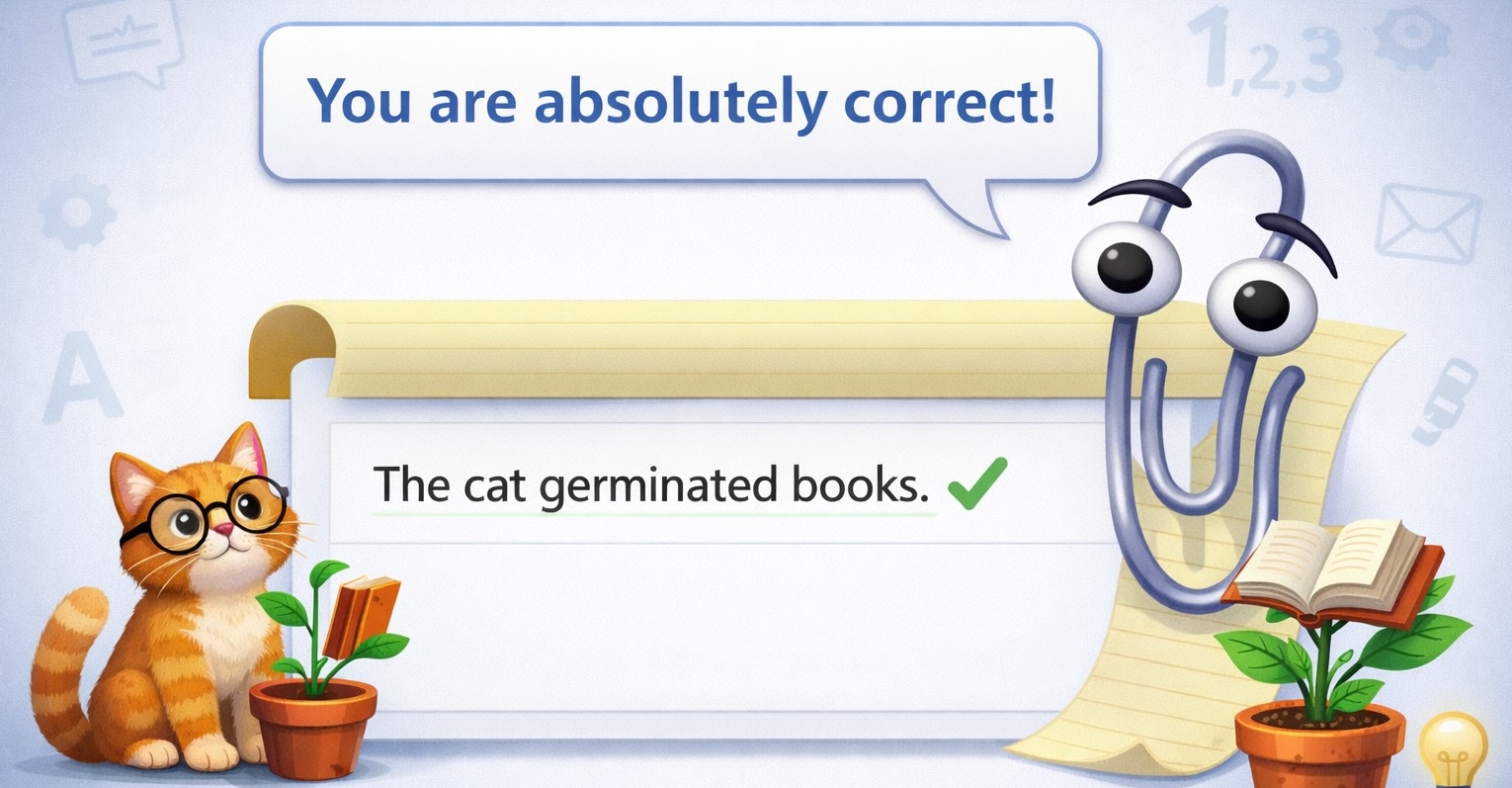
<p>To borrow from language (grammar), the syntax is the structure and rules that go into creating a valid sentence. The sentence “the cat germinated books” is syntactically correct, but semantically absurd. Yet, no spell or grammar check will flag it. They are syntactical products.</p>

<p>You know what else is like this? Pretty much every tech product: Word, Gmail, Photoshop, PowerPoint, Canva, Salesforce, Reddit, QuickBooks, Airtable, Jira, Slack, Visual Studio Code, Google Ads, and many more.</p>

<p>They give you the structure and rules of how to use it and then wash their hands and wish you good luck. Have you ever seen PowerPoint tell you that your pitch deck makes no strategic sense? Or, QuickBooks telling you that the way you are selling your services is generating a cash-flow crunch and you should consider focusing your marketing efforts in another customer segment?</p>

<p>Because of their own shortcomings, the organizations behind these products provide guidance on workflows, encourage books and training on how to use it correctly, and put together case studies to show how others have achieved semantic results from a syntactical product.</p>

<h2 id="semantic-products">Semantic Products</h2>

<p>The seeds of semantic products go back a long time. First, it was the realm of science fiction. Then, in the realm of theoretical AI in the 80s and 90s. And finally, during the early 2000s, it took center stage as the Semantic Web. The vision was for websites not simply provide HTML and text, but the context that describes what was in there.</p>

<p>Over the last two decades, many companies have added semantics to their products. Google Search did a great job of using semantics to understand user intent but also to render results that aligned with the user end goal. The knowledge graph became a thing at Facebook, Google, and Microsoft. The value of infusing a product with semantics is not a step change. It’s a 10X step change and a slope change on the value curve at the same time.</p>

<p>However, we fell short. The popular products I mentioned above did little except in the most basic aspects of semantics. Attempts at making these products “smart” required enormous effort to define and implement explicit rules that were carefully crafted to ensure the product wasn’t telling the user something stupid.</p>

<p>To make matters harder, many of the semantic needs are based on judgement and context, and it’s effectively impossible to create a set of rules.</p>

<h2 id="ai-meet-syntactical-product-aka-ai-native-10">AI, meet Syntactical Product (a.k.a., “AI-native 1.0”)</h2>

<p>If you are old enough, you might remember the websites of the 90s. First, it was just the marketing brochure converted into a website. Sometimes, they were literal scanned images of the brochure!</p>

<p>Over the years, websites became interactive, and you could do things. It took another decade for people to understand the read-write nature of the Web, and we called it “Web 2.0.”</p>

<p>The current integration of AI in Microsoft 365 and in Google Workspace doesn’t change the fact that these are syntactical products. They feel like brochureware from the 90s.</p>

<p>Gamma is the AI-native version of presentation tools. It delivers impressive organic integration with AI. Yet, I can’t help but think that Gamma doesn’t understand my goal and that the artifact I’m creating is a temporary step on my path to achieving my goal. Far be it from me to say that Gamma will not be successful. It will. It is. The alternative of using Google Slides or PowerPoint with AI is not a good fit anymore. But what comes after Gamma is way more interesting because it’s fully semantic.</p>

<p>Over the next five years, we’ll see every product in the catalog being disrupted by its twin(s) AI-native versions. This will spell trouble for horizontal solutions because segmented product offerings will be more effective. Instead of having a text editor like Google Docs or MS Word, we’ll have document writing tools specialized in the type of document being created — resume, PRFAQ, pitch proposal, press releases, PRDs, SOPs, grant proposals, etc. These specialized tools will focus on the goal and have the training data and user feedback that will rapidly improve their value.</p>

<p>The natural flow of writing a press release will from a basic Word template that provides formatting and fill-in-the-blanks paragraphs to a tool that looks at the other documents, presentations, and emails, asks me a bunch of questions, and together we create the press release.</p>

<h2 id="ai-native-20-letting-go-of-artifacts">AI-Native 2.0: Letting Go of Artifacts</h2>

<p>What’s holding founders and innovators back is that they think too much in artifacts and not in outcomes. My canonical example is when, in business, people talk about affordable health insurance. I point out that if you dig one layer deep, people don’t want health insurance; they want healthcare. And if you dig one more layer, you realize people don’t want healthcare; they want to be/get healthy. Giving people insurance is great, but “giving” people health is the goal.</p>

<p>People don’t want to write a press release, they want to be mentioned in the press. People don’t want to write a resume, they want to get a job. People don’t want to track deals on a CRM, they want to sell a product and close a contract. People don’t want to track their expenses, revenue, and taxes, they want to maximize their profit, and be guided in the tactics and strategy to achieve that goal. They don’t want to write code, they want to have a website that ranks high in search engines and GenAI chat products for their market and that converts customers.</p>

<p>This new wave of products will be the AI-native 2.0. It’s currently being called the Agentic AI, but who knows if the term will stick. The AI-native 2.0 will coexist with AI-native 1.0 that we are building today the same way we still have simple interactive websites that coexist with Web 2.0 websites.</p>

<p>It won’t be long before you’ll talk with an AI travel agent to organize a group trip, without ever having to visit a website to plan or buy anything. At most, you’ll provide additional context the agent can’t get from your digital footprint. We still have to build “Expedia 2.0” (Expedia + AI, which is not the same as adding AI to Expedia!) before we get to “Expedia 3.0” (agentic travel agent).</p>

<p>As much as investors, founders, and futurists want to believe we are just a few years away from this becoming a reality, there is a difference between the technology being ready and society being ready. We’ll have people with different levels of comfort with this technology for decades. Regardless of the problems we’ll encounter along the way, we are (re-)entering the Cambrian explosion of tech products, and it couldn’t be more exciting.</p>]]></content><author><name>Marcelo Calbucci</name></author><category term="hp" /><category term="tech" /><category term="ai" /><summary type="html"><![CDATA[]]></summary><media:thumbnail xmlns:media="http://search.yahoo.com/mrss/" url="https://calbucci.com/assets/images/ai-native-2.0.jpg" /><media:content medium="image" url="https://calbucci.com/assets/images/ai-native-2.0.jpg" xmlns:media="http://search.yahoo.com/mrss/" /></entry><entry><title type="html">SaaS and software are not dead</title><link href="https://calbucci.com/2026-agentic-saas" rel="alternate" type="text/html" title="SaaS and software are not dead" /><published>2026-01-18T00:00:00+00:00</published><updated>2026-01-18T00:00:00+00:00</updated><id>https://calbucci.com/2026-agentic-saas</id><content type="html" xml:base="https://calbucci.com/2026-agentic-saas"><![CDATA[<p><img src="/assets/images/agentic-saas.png" alt="image" /></p>

<p>This was a unique week. The tech world and the stock market world held hands. There was a convergence of the idea that AI will “eat” SaaS and software. It had a major negative impact on the stock market. In the world I live in, call it the “startup” industry, every VC and founder is also talking about it. The vast majority of VCs have declared that SaaS is done. Agents and vibe coding (or “agentic engineering,” the latest coined term by Andrej Karpathy) will replace software and SaaS companies.</p>

<p>There is something off about this prognostication.</p>

<p>Let me start by saying I don’t know what’s going to happen, but I have confidence in my bones that software and SaaS won’t go away. I actually think we’ll have more software and more SaaS, but it won’t be the shape we see it today.</p>

<p>First, I remember when the term SaaS was coined. It wasn’t about the narrow definition of SaaS today (cloud-based subscription). It was the (counter-)reaction to a world where you had to buy software once, pay a high upfront price for it, and then you needed to update that software (and pay again) every couple of years. Honestly, it wasn’t great for consumers and SMBs/Enterprises, and it wasn’t great for software makers.</p>

<p>For software makers, SaaS made it easier to have predictable revenue. It also changes the dynamic of software updates. In the past, you had to have enough new things in a new version of software to justify the customer paying for an upgrade. New releases would only come out every one or two years (three or four for operating systems). Deployed software was also a nightmare. It was incredibly hard to support different hardware, operating systems, and compatibility with other programs on the same server or desktop.</p>

<h2 id="people-dont-want-software-they-want-solutions">People don’t want software. They want solutions.</h2>

<p>The software makers’ world is easier with SaaS than with shrink-wrapped software. On the flip-side, SaaS brought a revolution to customers. We’ve been living in this software-is-easy world for 15 years. People have forgotten how it used to be.</p>

<p>In the early 2000s, frustration with your computer was a common thing. Most people would spend days or weeks trying to get something to work. A simple video editing software? Good luck with that! Get that CRM application installed and working on your new laptop? You’ll need IT for that! Update a driver, rename a file, change the registry, move it to the D: drive, download this clean-up tool. It was an F-ing nightmare!</p>

<h2 id="the-old-and-the-new-new-meet-again">The old and the new-new meet again</h2>

<p>I can’t see a world where the average person is solving their own problems with vibe-coded software. Most people cannot do this, no matter how friendly the tools and systems are. Most people don’t want that. People want the easy-button.</p>

<p>When an ex-executive from Amazon says they vibe-coded a CRM for their new startup over the weekend, or when a reporter says they built a project management tool in one hour, they aren’t talking about a full CRM or a proper project management tool. They built 1% of the feature set. They will have to go back to doing more vibe coding to add every other feature (spoiler: it won’t work). In the end, they will have an unmaintainable and unwieldy project.</p>

<p>I can’t see a world where SMBs or enterprises have dozens (or thousands) of in-house built solutions. Who’s going to maintain that? Who’s going to guarantee that security patches are applied? Who’s going to ensure that these tools are not one poor prompt away from DDoS-ing their own system?</p>

<h2 id="but-the-agents-will-eat-saas-right">But the agents will eat SaaS! Right?</h2>

<p>Let’s put vibe-coded software aside. We established that’s going to be a hard pill to swallow. What about agents that can do the work that a SaaS tool used to do? Isn’t that the future? Yes! Yes! Yes! But that <em>is</em> SaaS! Agents are software that run on computers, servers, or on your mobile device. They require someone to create, maintain, and often operate its backend.</p>

<p>ChatGPT, Claude, Gemini, and Copilot might seem like they are free/cheap, or bundled with what you already have. If you think these LLM tools will stay at the same price point they are today, I have a space station to sell to you. Every AI tool is heavily subsidized today because we are in the land-grab phase (remember Uber and Lyft in the 2010s?). Advancements in hardware and machine learning techniques have helped the cost drop significantly over the last few years, and they are still highly unprofitable.</p>

<p>Let’s hypothetically say they can replace a SaaS product that you or your company pay for: a project management, CRM, or inventory tracking tool. From an economic perspective, if you were paying $20/user/month for that tool before, now any of these vendors can price their offering just below $20, and that might be enough to convince you to switch to this new way.</p>

<p>We’ll also have the specialized agents layer. You’ll have companies launching agents that specialize in skills for all roles, from lawyers to veterinarians, from accountants to therapists. An agent that replaces a CRM tool and specializes in the hospitality industry will very likely disrupt a portion of the market for traditional horizontal CRM tool. And guess what, that new specialized agent is a SaaS product that a boutique hotel will pay for.</p>

<h2 id="human-labor---agent-labor">Human labor -&gt; Agent labor</h2>

<p>The last thing that I want to say is that agents will disrupt the labor force. People obsess about the idea of categories of job roles being eliminated. The best way to think about this is in terms of skills and not roles. A role is a collection of skills, knowledge, and activities. Agents will excel in some skills and flop in others. In practice, that doesn’t translate into the elimination of roles, but rather that roles will have fewer skills and activities to achieve the same goal when paired with an Agent. It means that organizations will need fewer employees to do the exact same work.</p>

<p>This creates an interesting situation. If an organization spends $1M in (human) labor in a specific role, and they can eliminate 30% of that workforce, where do you think those $300K in savings are going to go? If history and economics are any indicator, 30-50% of that money will go directly to the AI agent! More specifically, to the SaaS company that built and maintains that agent. Otherwise, it’s money left on the table, and there is nothing that capitalism hates more than under-optimizing gains.</p>

<p>This is my long-winded way of saying: 1) We’ll have ten times more software in the next decade than we have today (thank you vibe-coders!), and 2) tech companies (big and small) will be responsible for an even bigger share of the economy.</p>]]></content><author><name>Marcelo Calbucci</name></author><category term="hp" /><category term="tech" /><category term="ai" /><summary type="html"><![CDATA[]]></summary><media:thumbnail xmlns:media="http://search.yahoo.com/mrss/" url="https://calbucci.com/assets/images/agentic-saas.png" /><media:content medium="image" url="https://calbucci.com/assets/images/agentic-saas.png" xmlns:media="http://search.yahoo.com/mrss/" /></entry><entry><title type="html">2026: The Year of Humanity in the Age of AI</title><link href="https://calbucci.com/2026-ai-community" rel="alternate" type="text/html" title="2026: The Year of Humanity in the Age of AI" /><published>2026-01-06T00:00:00+00:00</published><updated>2026-01-06T00:00:00+00:00</updated><id>https://calbucci.com/2026-community</id><content type="html" xml:base="https://calbucci.com/2026-ai-community"><![CDATA[<p><img src="/assets/images/2026-age-of-ai.png" alt="image" /></p>

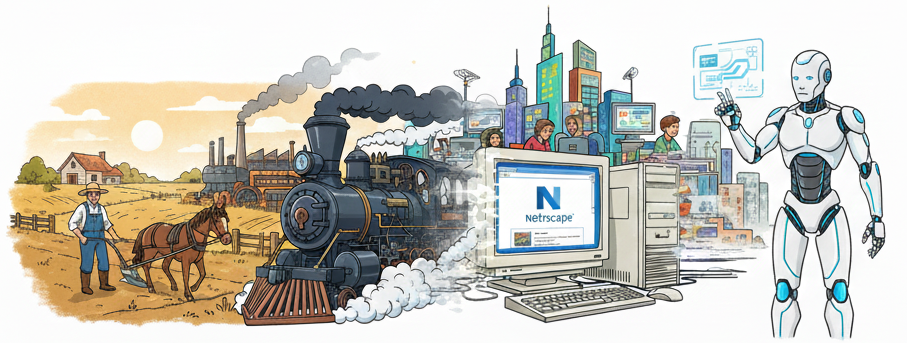
<p>Welcome to 2026! A decade or more from now, we’ll look back at 2026 as the year that cemented the foundation blocks for the new era for humankind. The industrial revolution started in 1760, but Adam Smith’s “Wealth of Nations,” published in 1776, is what gave humanity the framework to think about what was happening, and how to accelerate progress.
Similarly, the Information Age started in 1947 with the invention of the transistor, but it wasn’t until 1995, with the Netscape IPO and Windows 95, that really propelled tech adoption.</p>

<p>I hate to write my predictions so they can’t come back to haunt me, but I believe 2026 will be the 1995 of the AI era.</p>

<h2 id="humanity-vs-artificiality">Humanity vs. Artificiality</h2>

<p>Since OpenAI awed the world with the launch of ChatGPT in November 2022, we have been on this journey of what is appropriate or not for an AI to do (or to be). On one end of the spectrum, you have your AI maximalists, who believe AI should be everywhere and the purpose of humanity is to serve AI (sprinkle a transhumanism in there). On the other end, you have the AI-deniers who believe we must shut down the AI data centers and stop investing in this technology. Neither matters much, and I advise you to tune out those comments.</p>

<p>This moment lies in defining what it means to be human in the age of AI.</p>

<p>For thousands of years, only humans could perform certain tasks such as summarizing a book, writing poetry, answering a customer support call, or driving a car. Now that AI can do those things—and it’ll only get better—(em-dashes written by me), what’s the point of being a human?</p>

<p>Before the industrial revolution, with few exceptions, most humans lived for subsistence. They produced what they needed to live, or what their village/town needed. With the industrial revolution, we discovered that specialization and production-lines (even in farming) were a scalable and efficient means of running a society. Finally, the information revolution created layers of handling knowledge and data to benefit the layer underneath. And we’ve been piling on these layers for over a century.</p>

<p>AI will slowly dismantle those layers. AI will also dismantle the industrial revolution with self-driving cars, robots in factories, autonomous drones, and even farming. We are not far from having a farm fully managed and operated by a single individual behind a screen who’ll never touch the seeds, the ground, or a fertilizer.</p>

<h2 id="making-meaning-and-living-in-societies">Making meaning and living in societies</h2>

<p>As I pored through a long list of definitions of “humanity” from philosophers and scientists, I found only three definitions that withstand the AI era:</p>

<p>1) Self-awareness (Descartes) — consciousness of our own existence.
2) Social-relational (Aristotle/Buber) — we exist in a relationship and our identities are formed through others.
3) Labor-purpose (Marx/Frankl) — We find meaning through work and contribution.</p>

<p>Although Descartes’ definitions of consciousness and existence make for a great midnight dorm-hallway conversation, I don’t think they bring any practical value to the human-machine relationship in the AI era. Frontier AI researchers love to have these debates, but it brings little to no practical application to our lives.</p>

<p>The other two are phenomenal and practical.</p>

<p>Aristotle declared that humans can’t fully realize themselves without a community. Martin Buber extended this idea by going one step further and saying that a person isn’t a solo project but emerges through relation.
Regardless of your feelings about Marx, he stated that what makes us human is our conscious productive activity. In other words, we are what we do! Which is parallel to Viktor Frankl, a Holocaust survivor’s, belief that our motivation comes from seeking meaning.</p>

<h2 id="community">Community</h2>

<p>The community will take (back) the centerpiece of our society, starting in 2026. Over the last few decades, and particularly over the last 15 years, mobile devices and social networks have connected the world. Yet, it drove us farther apart. Dating apps went from a fringe tool to widespread adoption, and now they are collapsing. They didn’t deliver the authentic connection humans seek. Social media has made it ever easier to share ideas and learn from others, and now they are dominated by bots and rage bait. Digital services that were meant to connect the world, divided it. Third-spaces are a declining phenomenon, even in countries where the cultural norms are built around multi-generational social groups.</p>

<p>The data about friendship, dating, loneliness, and helplessness are quite bleak(1). This has led to peak depression and anxiety diagnostics, particularly for those born after 1990. They don’t know a world without the Internet. As a society, we dug ourselves a hole. We either hit bottom or are close to it.
Why 2026?</p>

<p>Change is super hard. For the last three years, AI has taken people for a spin, in their personal and professional lives. Healthcare, education, finance, work, customer support, and other areas are changing. This will continue for the next few years, but we are already seeing some “stabilization.” LLMs are becoming faster, better, and cheaper, but they are still doing the same job they were doing a year ago. We are seeing new products built on top of a stable(-ish) foundation. Even though things are still changing fast, we have a predictable pace of change, and the fog of the future is clearing. That stability will help us to see AI for what it is—instead of fearing it—and also allow us to focus on the other side, the human.</p>

<p>We have an unresolved issue with work. People suggest that universal basic income (UBI) and the “age of abundance” will address the shortage of work opportunities. From an economic point of view, if UBI and abundance exist, that would be enough. However, it doesn’t give people purpose. Regardless of money, we need work that makes us feel seen, skilled, and valued(2). I have yet to see an answer to this unaddressed problem. Every proposal so far feels idealistic, impractical, or denialist. It’s a severe problem in the US with its weak labor laws and non-existent social safety nets.
In 2026, we’ll see a burst of ideas and initiatives to bring people together to create genuine connections. Apps that organize group dinners with strangers, a resurgence of running clubs, people (even men!) being vulnerable on social media seeking others for activities, etc. Not a swipe left/right, not a faceless post on Reddit, not a coworker behind a screen. We’ll see a desire to build things together and in-person; a multitude of events around music, hobbies, and shared interests; and a rebirth of flirting and approaching people when you are out-and-about. These won’t happen by the end of the year. As I said at the beginning of this article, a decade from now, we’ll look back at this moment and say, “That’s when it started.”</p>

<p>AI won’t take our humanity because our humanity is about other humans. It’ll reinforce it.</p>

<p>===</p>

<p>(1) Book: <a href="https://amzn.to/3N0EL2r">Together: The Healing Power of Human Connection in a Sometimes Lonely World</a> by Vivek H. Murthy, MD</p>

<p>(2) Quote from <a href="https://www.threads.com/@mshobe/post/DS3-iTLlAez?xmt=AQF0Y3dcXsut3KBxdnmBkAnWGFTREOs7j2KzX8Qwfkt4nA">Matt Shobe</a></p>]]></content><author><name>Marcelo Calbucci</name></author><category term="hp" /><category term="tech" /><category term="career" /><category term="ai" /><summary type="html"><![CDATA[]]></summary><media:thumbnail xmlns:media="http://search.yahoo.com/mrss/" url="https://calbucci.com/assets/images/2026-age-of-ai.png" /><media:content medium="image" url="https://calbucci.com/assets/images/2026-age-of-ai.png" xmlns:media="http://search.yahoo.com/mrss/" /></entry><entry><title type="html">Why headlines about AI displacing jobs don’t match reality</title><link href="https://calbucci.com/ai-displacing-jobs" rel="alternate" type="text/html" title="Why headlines about AI displacing jobs don’t match reality" /><published>2025-10-16T00:00:00+00:00</published><updated>2025-10-16T00:00:00+00:00</updated><id>https://calbucci.com/ai-displacing-jobs</id><content type="html" xml:base="https://calbucci.com/ai-displacing-jobs"><![CDATA[<p><img src="/assets/images/ai-displacing-jobs.jpg" alt="image" /></p>

<p>There are two narratives unfolding in the press, in VC/founder circles, and in the boardroom. One is about AI automation and job displacement. The other is about layoffs, hiring freezes, and a shortage of entry-level positions. As expected, we assume these are intertwined.</p>

<p>There’s just one problem. The data doesn’t support a correlation at this point.</p>

<p>A comprehensive <a href="https://budgetlab.yale.edu/research/evaluating-impact-ai-labor-market-current-state-affairs">recent analysis by Yale’s Budget Lab</a> argued the current wave of AI tech made no discernible impact on the labor market. The study showed the occupational mix change mostly matches previous tech waves. In other words, AI is another tool that follows the same technology adoption curve we know.</p>

<p>There are valid concerns that AI will affect roles. Some will see efficiency gains, reducing the number of required humans to achieve the same result; some will be automated, replacing workers. The timeline in the current narrative doesn’t match the truth on the ground, though.</p>

<h2 id="the-real-culprits">The Real Culprits</h2>

<p>What’s happening in the labor market is more nuanced (and mundane) than the AI disruption story suggests. We love to think we are living in unprecedented times. Yet, we are seeing the same patterns from corporations as we saw during the financial crisis of 2008 and the dot-com bust in 2000: layoffs, hiring freezes, cost cutting, etc.</p>

<p>The difference between those two crises and now is that we have multiple once-in-a-decade events happening in the last five years.</p>

<p>These are five explanations for what we are seeing today that are not related to AI.</p>

<p><strong>Covid Correction</strong>: Companies, particularly in tech, dramatically over-hired during the “Covid boom.” Amazon doubled its workforce. Peloton expanded manufacturing capacity. Zoom was a sure bet stock to buy. The demand to improve the tech stack to enable remote workers drove major adoptions across industries, boosting demand for products from Microsoft, Google, Salesforce, and other tech vendors. Companies were hiring talent, projecting an over-optimistic growth curve. In some cases, big tech was hiring talent to prevent a competitor from hiring them!</p>

<p><strong>Supply Chain Hangover</strong>: Covid not only caused manufacturing plants to shut down for months, but it also affected shipping and transportation. There were many single points of failure in our global supply-chain system. Combine that with considerably higher demand for certain products, and the result was a shortage that drove inflation up. To this day, we have not fully recovered back to historical inflation levels.</p>

<p><strong>The End of Cheap Money</strong>: For over a decade, the Zero Interest Rates Policy (ZIRP) fueled aggressive growth strategies. Cheap capital meant companies prioritized growth, and investors prioritized long-term strategies over short-term profits. The abrupt end led to a fundamental shift in business strategy. It didn’t help that from 2022 onward, a provision in Section 174 of the Internal Revenue Code changed how companies could classify their R&amp;D expenses (such as the cost of a software engineer), going from being an incentive for innovation and startups to a hindrance.</p>

<p><strong>Trade Uncertainty</strong>: New tariffs and threats of additional trade restrictions create business uncertainty. When companies can’t predict with confidence their cost structure or market access, they delay investment and slow down hiring.</p>

<p><strong>Performance Management</strong>: This is not a cynical point since CEOs have explicitly called out employee performance as a reason for cuts and hiring freezes. Meta’s Mark Zuckerberg called 2023 the “Year of Efficiency” to justify layoffs at the company. If you ask people working in big tech, they will agree that teams became bloated, and some people were doing little work.</p>

<h2 id="ai-adoption-reality-check">AI Adoption Reality Check</h2>

<p>AI will upend major job roles, like other major technological advancements have done. It’ll do it faster than the previous shifts, making it harder for society to adapt during the transition period. There are 175 million people in the U.S. labor force in 1,057 unique roles (using the NAICS classification). A few of these roles will go through major transformations in the coming years, a few will take a decade or more, and many will take longer or won’t be impacted at all.</p>

<p>On one hand, you have a role such as an airplane pilot that won’t go away anytime soon. To create an autonomous plane requires a technology we don’t have today, and society won’t feel comfortable with it anytime soon. On the other hand, you have customer support and call center operators that are already being displaced by AI. Though there were <a href="https://www.businessinsider.com/klarna-reassigns-workers-to-customer-support-after-ai-quality-concerns-2025-9">setbacks</a> in rushing it, it’s almost certain that in the next five years we’ll go from a 2.5 million labor force working on these roles to a tenth.</p>

<p>The question isn’t whether AI will eventually reshape more occupations, but rather which ones, how quickly, and to what degree. Most predictions from the last few years have not only been wrong, but they were widely wrong! Most predictions about what’s coming will be similarly widely incorrect. The solution to calm this anxiety is to embrace uncertainty and adaptability.</p>

<p>(This post was <a href="https://www.geekwire.com/2025/column-why-headlines-about-ai-displacing-jobs-dont-match-reality/">originally published on GeekWire</a>)</p>]]></content><author><name>Marcelo Calbucci</name></author><category term="hp" /><category term="tech" /><category term="career" /><summary type="html"><![CDATA[]]></summary><media:thumbnail xmlns:media="http://search.yahoo.com/mrss/" url="https://calbucci.com/assets/images/ai-displacing-jobs.jpg" /><media:content medium="image" url="https://calbucci.com/assets/images/ai-displacing-jobs.jpg" xmlns:media="http://search.yahoo.com/mrss/" /></entry><entry><title type="html">Learn Computer Science</title><link href="https://calbucci.com/learn-computer-science" rel="alternate" type="text/html" title="Learn Computer Science" /><published>2025-01-25T00:00:00+00:00</published><updated>2025-01-25T00:00:00+00:00</updated><id>https://calbucci.com/learn-computer-science</id><content type="html" xml:base="https://calbucci.com/learn-computer-science"><![CDATA[<p><img src="/assets/images/learn-computer-science.png" alt="image" /></p>
<figcaption>Learning how to exit VIM.</figcaption>

<p>I’ve been thinking about the value of learning computer science, particularly at a young age, even for those who will not pursue a career in software engineering or in tech. Tech layoffs are widespread and are here to stay. Tech jobs are getting harder to find. AI is affecting organizations’ appetite to grow their tech teams. I hear from time-to-time that learning programming and computer science is a waste of time and won’t provide future value.</p>

<p>I disagree!</p>

<p>Eight of the ten richest people in the world either studied computer science in college or have meaningful exposure to CS in college or early in their career. Jimmy Wales, the creator of the biggest encyclopedia of the World, studied computer science. Renaissance Technologies, the most successful investment company in the world, was founded, and it’s operated by people with computer science experience. David Baker, a computational biologist, was awarded the 2024 Nobel Prize in Chemistry—in chemistry!</p>

<p>Among the top YouTubers and creators, you’ll find plenty of people who studied or learned computer science to a certain extent: Marques Brownlee (MKBHD), Destin Sandlin (Smarter Every Day), Derek Muller (Veritasium), Randall Munroe (XKCD), Simone Giertz, and more.</p>

<p>If you go to Amazon and pick the top 100 books, you’ll find that a disproportional amount of them were written by people who studied computer science, formally or informally. Why?</p>

<p>Is it selection bias because being admitted to a CS major is hard so it screens for people who were already smart? I don’t think so. Most of the people that I mentioned above learned computer science before it was a competitive field.</p>

<p>In my opinion, the answer is the breadth of skills that you develop when studying computer science, even if you are doing an introductory class in middle school. Learning computer science offers benefits that go beyond programming or working in the tech field.</p>

<p>⭐️ Problem-solving Mindset: It encourages systematic thinking. You learn how to break down complex problems into sub-problems and solve each piece (a.k.a., divide-and-conquer).</p>

<p>⭐️ Abstract Thinking: It helps you look at ideas and systems from a high-level perspective, identify patterns and relationships before going into the specifics.</p>

<p>⭐️ Logical Reasoning: Writing and running your code helps you develop a structured approach to reasoning and better understanding of cause-and-effect—It’s also a dopamine hit when it works!</p>

<p>⭐️ Creativity &amp; Innovation: Experimenting with programming foster a mindset of exploration, curiosity, and learning from failures. You are constantly asking yourself, what if?</p>

<p>⭐️ Research Skills: It encourages you to learn how to find answers even when you are not clear about what you are looking for.</p>

<p>⭐️ Analytical Thinking: It helps you understand how to handle data, develop and test hypothesis, and analyze problems.</p>

<p>I don’t think there is any other class in K-12 that has these combined benefits. Even for adults who are learning it for the first time, I can’t think of an equivalent practice that you do by yourself (or in a classroom) that packs those skills together.</p>

<p>I’m not arguing that everyone should become a professional programmer, but I do believe there are tremendous benefit to learning to program. I’m also not saying that other fields are not valuable or important. Every once in a while, you see someone pushing back against teaching kids computer science and arguing that we should teach kids more about art, so they develop more empathy. These are not conflicting ideas. Kids can be taught both, and more.</p>]]></content><author><name>Marcelo Calbucci</name></author><category term="hp" /><category term="tech" /><category term="career" /><summary type="html"><![CDATA[Learning how to exit VIM.]]></summary><media:thumbnail xmlns:media="http://search.yahoo.com/mrss/" url="https://calbucci.com/assets/images/learn-computer-science.png" /><media:content medium="image" url="https://calbucci.com/assets/images/learn-computer-science.png" xmlns:media="http://search.yahoo.com/mrss/" /></entry><entry><title type="html">On writing my first book!</title><link href="https://calbucci.com/writing-my-first-book" rel="alternate" type="text/html" title="On writing my first book!" /><published>2025-01-08T00:00:00+00:00</published><updated>2025-01-08T00:00:00+00:00</updated><id>https://calbucci.com/Writing-My-First-Book</id><content type="html" xml:base="https://calbucci.com/writing-my-first-book"><![CDATA[<p><img src="/assets/images/PRFAQ-SocialMedia-BookStacked.png" alt="image" /></p>

<p>I just published “<a href="https://www.theprfaq.com">The PRFAQ Framework</a>”, a book I authored and self-published. I learned about the writing process, the book industry, and how to publish and promote a book from this experience.</p>

<p>When I started with my journey, I reached out to friends who have published books, bugging them with basic questions. I’m writing this post to help others who are considering authoring and publishing a book as well, going into the nitty-gritty of this process.</p>

<p>The first thing that I learned about authoring and publishing a book is that there are different tools, approaches, and best practices, depending on the genre. Most of the content and resources you’ll find online are for fiction books. My book is a non-fiction, non-biography, business and management book. There is very little content available for this type of book. On the one hand, this is good. It’s a sign there is less competition in the market (or is it bad because there is less demand?). On the other hand, you have to figure out a lot of things by yourself.</p>

<h2 id="the-idea">The Idea</h2>

<p>My original intent was to write a series of articles about the PRFAQ framework, what I learned at Amazon, and how it applies to early stage founders. After twenty years building startups, mentoring and advising founders, and participating in the startup/VC community, I had clarity on how PRFAQs are useful for founders and investors.</p>

<p>When I left Amazon, I was about to build a new startup (related to PRFAQs/writing). I thought of the articles about the PRFAQ framework as “content marketing.”</p>

<p>You know when you learn a new word or term and then you start seeing it everywhere? Well, as soon as I started to pay attention, I saw many well-known thought leaders talking about the advantages of using writing to think, pitch, and persuade. Then, I saw this:</p>

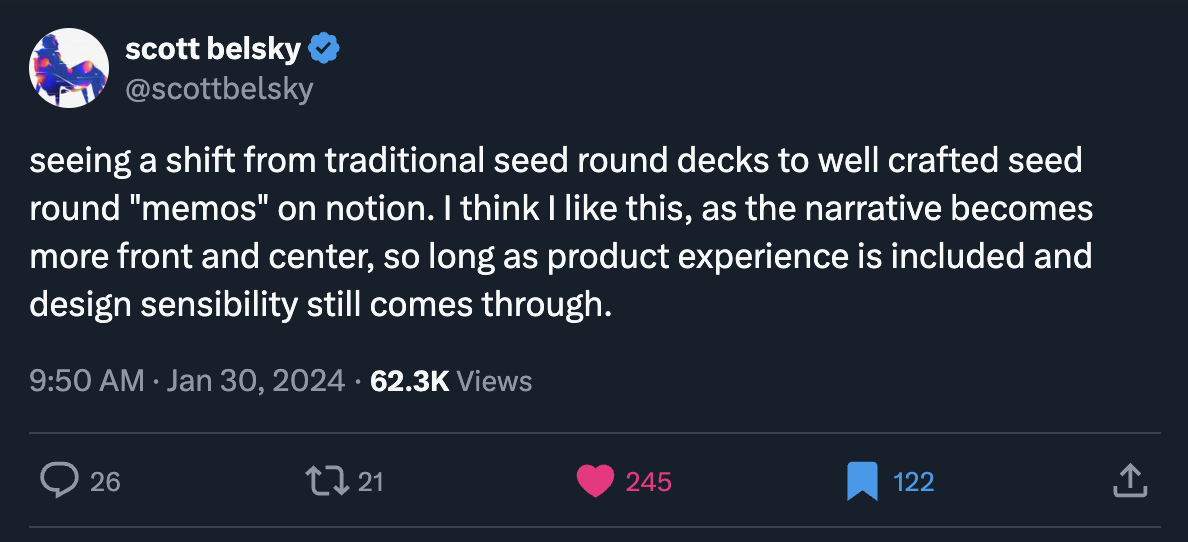
<p><a href="https://twitter.com/scottbelsky/status/1752388863681835321"><img src="/assets/images/scott-belsky-tweet.png" alt="Alt Scott Belsky: seeing a shift from traditional seed round decks to well crafted seed round &quot;memos&quot; on notion. I think I like this, as the narrative becomes more front and center, so long as product experience is included and design sensibility still comes through." /></a></p>

<p>This tweet from Scott Belsky (the founder of Behance, CPO at Adobe, and the author of The Messy Middle) was the tipping point for me to realize the opportunity was bigger than a series of articles.</p>

<p>I wanted to write a book for a long time. I started writing a few times but never found the time to do it consistently while having a full-time job. Back in February 2024, I decided to put the startup on the back burner for a couple of quarters and focus on the book first.</p>

<h2 id="the-target-audience">The Target Audience</h2>

<p>The first working title of the book was “PRFAQ for Startups.” I wore my product manager hat and thought about the customer, the pain points, the jobs-to-be-done, the solution, and the go-to-market for the book. What was available today? What was the opportunity? What do customers (founders) need?</p>

<p>I did research to understand the ideal customer profile (ICP) and quantify the total addressable market. I treated my book like a founder treats a SaaS product idea.</p>

<p>I estimated there are between 50,000 and 80,000 new “startups” every year. That includes startups that come to exist and the startups where founders give up before doing much—I called these “pre-founders”. The 50,000 to 80,000 have an overlap from year to year. It’s not like 50,000 new founders found a startup each year.</p>

<p>Out of that group, you discount people who don’t read books, people who are not interested in PRFAQs, people who don’t speak English well enough to read my book—well, it’s a pretty small market, but an interesting niche.</p>

<p>A friend told me that books in the business category sell 5,000 to 6,000 copies in the first three years. This market data, with my top down estimates, made me happy to write a book where a few thousand people would read it.</p>

<p>However, as I did research for the content of the book, I realized that I could expand the audience of the book. The obvious segment to expand into was product managers at large and medium size tech companies. There are another 50,000 to 100,000 of those out there. This is also a segment I’ve worked in for the last two decades, so I could draw content from my experience without having to do much research. Besides that, there are another 500,000-1M product and program managers in corporations across the US.</p>

<p>From a jobs-to-be-done perspective, I realized the problem I was solving wasn’t limited to founders or product/program managers.</p>

<p>This was a book for anyone who needs to think critically about a problem and a solution while working with others, be able to articulate them to garner support (approval, funding, grants, etc.), and who want to rally people around a vision and a strategy. Yes, it doesn’t roll off the tongue easily, but that’s how broad I believe the use cases for PRFAQ are. These are innovators. People who are creating a new business, product, program, or service, or changing an existing one.</p>

<h2 id="research-phase">Research Phase</h2>

<p>I consume a ton of content. I read anywhere from five to ten books per year. I listen to hours of podcasts every week. I watch YouTube videos while exercising at home, and when I want to learn something new. My first action was to learn about the process of authoring and publishing a book. I read books, articles, Reddit posts, listened to podcasts, and watched countless YouTube videos on book writing and self-publishing. I spent a month on that topic and concluded I could do it. I wanted to do it.</p>

<p>The next wave of research was more complicated. I wanted to understand what had been written about PRFAQs (almost nothing), what people thought about PRFAQs, and what were the alternatives to that framework. I read about a dozen books on strategy, decision, writing, pitching, storytelling, etc. I interviewed about forty founders, a dozen product leaders, and a dozen VCs and managing directors of startup studios, incubators, and accelerators. The one audience I was interested in the most was people who worked at Amazon, left, and founded a startup or joined another company. Were they using PRFAQs? If not, why not? What have they tried? What worked? What didn’t?</p>

<p>When I was reading books, I would keep a notepad next to me, and scribble important notes on it. Those would include chapter ideas, quotes, interesting topics, insights, etc. When I was listening to podcasts (while driving or running), I would use the Voice Memo app on my watch. Then, I would transcribe the voice memos and paper notes into a Notion document. While interviewing people, I would also use a notepad if we were in person or use Notion to take notes for virtual meetings. Those also got transcribed into my master Notion list of content ideas and insights. For example, I would be talking to someone and they would say, “for me, the writing process is more important than the content I wrote because it helped me think through the problem.” I clustered that quote around other quotes of people who said similar things.</p>

<p>[Side note: in the book I speak about a method called Collect-Collate-Compose to write a PRFAQ that is applicable to books or any writing.]</p>

<p>At one point, after six weeks, I felt I had enough content to start writing the book.</p>

<h2 id="the-first-draft">The First Draft</h2>

<p>I wrote the chapter outlines of the book several times. First, I would be happy with that version of it. The next day, I would think it was crap and redo it. At one point, I felt I had clarity on the right outline, and I sat down to write.</p>

<p>I wrote the entire first manuscript in three weeks. I would start writing around 9am and write for  two hours, taking breaks as needed. Then, I’d write for one or two more hours in the afternoon. I used an app called Ulysses for Mac. It’s specifically designed for people who are writing long form text. I wasn’t a huge fan of Ulysses, and I don’t think I used it as it was meant to be used. It did the job, and I really liked that it used Markdown with no fuss.</p>

<p>My rule of thumb was to write 3,000 to 4,000 words per chapter, and 1-2 chapters per day, without worrying a single bit about grammar, spelling, and how chapters connected to each other. I flushed out the ideas in my brain to the “paper” without constraints. I knew that editing would reduce the number of words and simplify passages, so I didn’t limit myself.</p>

<p>If I got stuck in a chapter, I stopped and went for a run, came back, and finished it.</p>

<p>After the chapters were done, I took a break for a couple of days and then I read the draft manuscript for the first time. I went through each of my notes in Notion and marked them “done” if I wrote about it—like a checklist. I covered 80% of the notes in the first manuscript, and missed several other important topics that I had to add in. For example, I really wanted to talk about confirmation bias. I realized that after the first manuscript, I wrote about what it was, but not how to think about it, and how to defend against it.</p>

<h2 id="revisions">Revisions</h2>

<p>This is the part that caught me by surprise the most. You will do a lot of revisions in your manuscript. A lot! I guess if you are working with a publisher, they will share that load with you.</p>

<p>At this point, I hadn’t decided if I was going to self-publish or not, but I wanted to do the revisions myself. My first manuscript had 55,000 words. Each round of revision took three to five. The first revision, I did a grammar and style pass, using no tech tool, on Ulysses. I did two more revisions on Ulysses, where I shuffled paragraphs within or between chapters, and even shuffled (and renamed) chapters.</p>

<p>Then, I moved the content to Microsoft Word. For better or for worse, Word is the official tool for book authors and publishers. The fifth revision was the first one where I used Word to help with grammar, style, and spelling. During this revision process, I was still researching, interviewing people, and testing ideas to see if they made sense. Each time, I would go to Notion and add more bullet points to the list of things to add, remove, or update in the book.</p>

<p>Here’s what it took to get this book from the first manuscript to the final version:</p>

<ul>
  <li>Manuscript — me — 3 weeks</li>
  <li>3 content revisions — me — 3 weeks</li>
  <li>Grammar/spelling/style revision — me — 1 week</li>
  <li>2 content revisions - me - 1 week</li>
  <li>Editorial assessment — Editor — 10 days</li>
  <li>2 content revisions — me — 2 weeks</li>
  <li>Development Editing — Editor — 2 week</li>
  <li>2 content revisions — me — 2 weeks</li>
  <li>Copy Editing — Editor — 2 weeks</li>
  <li>1 content revision — me — 1 week</li>
  <li>Interior design — Designer — 1 week</li>
  <li>Proofreading — Proofreader - 1 week</li>
  <li>1 content revision — me — 1 week</li>
  <li>Final interior design — 1 week (+2 weeks for ePub hassles)</li>
</ul>

<p>That adds up to 23 weeks — which happened between May and November 2024. As I mentioned before, revisions took as little as three days and as long as five. I estimate that I spent 50% of my time either waiting for editors/proofreaders/designers to do their work, “beta readers” to send feedback, or I was taking a break on purpose to refresh and re-energize my brain.</p>

<h2 id="aillm">AI/LLM</h2>

<p>I’m as fascinated and a user of LLMs as the typical early-adopter. For this book, I decided not to use LLM to write or edit a single sentence in the book. I had three reasons for this choice. First, and most importantly, I wanted to be a role model for what I teach in the book. The book is about using writing as a mechanism to think critically and to learn how to develop and articulate ideas. LLMs are the antithesis of that. Second, I find LLM writing bland. Every time someone says they used an LLM to write a blog post and it turned out great, my first reaction is not to think the LLM did a great job — it’s thinking that this person doesn’t know what good writing looks like. Lastly, I wanted to tell my audience that AI did not create what they are reading. I believe people value human-generated content more than AI generated content — and that value will only grow the more AI content exists.</p>

<p>I used LLM extensively to do research for the book! I’d ask questions about other books, authors, insights, and concepts. I used it to figure out if people had done research on a topic, or if it could find a paper or article about a story I heard. I had ChatGPT open at all times on my computer. I also used Google Scholar extensively during the research phase of the book.</p>

<p>Interestingly, between May and November 2024, LLMs became much better at using the Web to search for information. ChatGPT 4o was a gift.</p>

<h2 id="the-book-team">The Book Team</h2>

<p>Honestly, I was clueless about who I needed on my team to write a book. Pretty much everyone knows about book editors, but not about other roles. I was also uninformed about what an editor actually does. Well, turns out there are multiple levels of editing and people who specialize in them:</p>

<ul>
  <li>Editorial Assessment: An overarching review of the content of the book and its strengths and weaknesses — this is where you’ll discover missing chapters, concepts that were introduced in one part of the book referenced earlier, missing explanations, etc.</li>
  <li>Development Editing: Big picture review of the manuscript and how it’s structured, the “plot,” the pacing, etc. — this is where you’ll find inconsistency between chapters, headings/subheadings that are confusing, lack of cohesiveness within a chapter, stories that have a beginning but are missing an end, etc.</li>
  <li>Copy Editing: It’s a line-by-line editing, focusing on grammar, spelling, word choice, sentence structure, readability, stylistic consistency, etc.</li>
</ul>

<p>This is not all! After that, you still need a proofreader. I asked my editor if I really needed one, because they did such a great job. I had reviewed the book a dozen times, and dozens of people have reviewed and provided me feedback. Well, it turned out you do need a proofreader. In tech terms, they are your Quality Assurance team. They have an incredible eye to find mistakes that are obvious once you see it, but hard for the untrained eye to catch it.</p>

<p>I was surprised when my proofreader found 200 issues in my book! It included grammar issues, typos, consistency issues, capitalization issues, and your mundane formatting issues (too much space between paragraphs, numbered lists with the wrong start number, indentation issues, etc.)</p>

<p>Writing a book is not like writing software, where you can frequently make updates to make it better. It’s a “one and done” thing, and I really wanted to publish the best product I could make. You can release revisions and new editions of a book, but you can’t update a copy someone already has on their bookshelf or on their Kindle.</p>

<p>You also need a cover designer and an interior designer. I was lucky to find someone with great experience with both. She was not only very experienced; she was super fast.</p>

<p>The two services I used to find professional help were <a href="https://reedsy.com/">Reedsy</a> and <a href="https://www.upwork.com">Upwork</a>. I really liked Reedsy because it helped me understand all the steps in book publishing, and the quality of their talent is outstanding. Upwork can be a bit overwhelming if you don’t know how to evaluate the skills of a talent. I used Reedsy to find an editor, and Upwork to find a designer (cover/interior), and a proofreader.</p>

<p>It’s really hard to hire talent on Upwork. It’s a vibrant marketplace, but it’s easy to get overwhelmed with offers. It’s also hard to know people’s true experience and if they are being honest in their representation. I won’t write about how to find the right talent on Upwork, but if you are not familiar with the platform and how to screen and evaluate people, I recommend you find the people you need on Reedsy.</p>

<p>I did the authoring, illustration, indexing, marketing positioning &amp; strategy, book website, and newsletter by myself.</p>

<h2 id="why-self-publishing">Why self-publishing?</h2>

<p>Disclaimer: This part will upset some people!</p>

<p>This was a difficult decision. If you are a well-known author or a celebrity of sorts (millions of followers), using a book publisher is the way to go. If you are publishing a complex book, like a cookbook, an engineering book, or a book with lots of illustrations or photography, I also think using a publisher is a good choice. In the realm of business/management/entrepreneurship books, I conclude that self-publishing is best. You lose three things if you use a publisher: 1) Editorial control, 2) Royalties, and 3) Control of timeline. However, by not using a publisher, you  lose the book publishing and publicity apparatus they bring to the table—a team of experts, a deep understanding of market and marketing, and their channel power with Amazon and bookstores.</p>

<p>I spoke with ten authors I know, including New York Times best-sellers. None of them, zero, zilch, were happy with their publisher and most of them advised me to self-publish. The reason given was similar — the financial trade-off you make between having lower royalty fees and a book publisher vs. having a higher royalty and doing your own marketing is not worth it.</p>

<p>Book authors already make little money. In the category I’m publishing, if you sell a book for $30 at retail, at best you’ll make $7 or $8 per copy sold if you self-publish. Using a publisher, your royalty drops to half that, or lower. Because they print in batches, if the book is not selling as expected, they drop the retail price of the book, sometimes by 50%. Your $30 book now is being sold at Amazon for $15. Your $3-4 royalty now becomes $1-2/copy!</p>

<p>Imagine working six months on a book and making $6-30K in three years!</p>

<p>The pitch from publishers is that they will help you sell more books using their “special sauce.” The authors that I spoke to didn’t believe it was worth it. They still had to do most of the legwork to get reviewed by creators and influencers, to appear on conferences and podcasts, and to be mentioned in articles and other publications.</p>

<p>Eons ago, an entrepreneur friend of mine (who was a master of getting his company mentioned in the press) said the secret to hiring a PR agency was to find one where you’d be the #1 or #2 client. His reason is that these clients get 80% of the attention and energy from the agency, while #3-100 clients get 20%. I extrapolated that to the book publisher world as well. If you are Malcolm Gladwell, Walter Isaacson, or Simon Sinek, the publishers will use their whole arsenal to help drive sales for those books. If you are not, oh well, here’s some tips to help you market your own book.</p>

<p>Another thing that didn’t excite me about the book publishing world is how slow it is getting a book published. The industry is quite broken in the way it approaches this problem, and it seems to have no rush or desire to fix it. I know authors who took over two years to get their book from manuscript to book shelves. That’s a deal breaker for me.</p>

<h2 id="book-authoring-cost">Book Authoring Cost</h2>

<p>The cost of authoring and publishing a book, in business &amp; management, varies by the book size (physical size, number of pages, and number of words), and by how much you want to do yourself. You can hire a ghostwriter to do the writing and that’s going to cost anywhere from $5K to $50K (or more). You can also join a service like <a href="https://manuscripts.com/">Manuscripts</a> that will coach you how to write and hold your hand while you publish a book (with a publisher or without one). If you want a book website (yes, you want a book website), you’ll have to pay for that if you can’t do it yourself. Illustration, marketing strategy, promotions, translation, audiobook, coaching, query letters, advertising, and other activities add up to the cost of self-publishing.</p>

<p>In my case, this is the cost to author and publish the book, excluding publicity:</p>

<ul>
  <li>Website: ~$400/year (domain name, Webflow, Zapier)</li>
  <li>Newsletter: $200/year (Kit.com)</li>
  <li>Editing: $3,000 (Reedsy)</li>
  <li>Cover Design + Interior Design: $1,200 (Upwork)</li>
  <li>ISBN (block of 10): $300</li>
  <li>Company Formation: $500 (Stripe Atlas) — Not needed</li>
  <li>Proofreader: $1,100 (Upwork)</li>
  <li>Total: ~$6,700</li>
</ul>

<p>There are other expenses that I didn’t include here because they aren’t “necessary.” Those include: ChatGPT Subscription, Virtual Mailing Address, Branding, Headshot, Indexer, books you’ll read, newsletter subscriptions, and the coffees/meals you’ll have with folks you are interviewing and getting advice from. Also, not included is any translation for publishing in other countries, and the cost of doing an audiobook ($5-8K). I haven’t done those yet, although the hardcover will be available in nine countries and the ebook will be available in thirteen countries, all in English.</p>

<h2 id="book-pricing--revenue">Book Pricing &amp; Revenue</h2>

<p>When they say authors don’t make money from a book, it’s true. Bookstores (online or retail) expect to make a 50% margin on books with onerous terms for returns and unsold copies. Your typical business book sells for $20-$40 when it launches in the US, and it drops in price in subsequent years. I was actually surprised how little data and information I found about pricing a book online, not even in the self-publishing subreddits. Again, most books are fiction, so the information you’ll find is about people self-publishing fantasy, romance, short stories, or children’s books.</p>

<p>After retailers take their cut, publishers also get their portion of the sales before authors are paid. That includes printing cost, publishing cost, marketing cost, and royalties-share. That’s why authors only make a few dollars per copy sold. Here’s sad math: Let’s assume an author invested eight weeks (320 hours) writing, revising, and preparing the book, with the help of the publisher. If the author makes $4 per copy (generous), and they sell 6,000 copies over a three-year period, that’s about $24,000 for 320 hours of work, which is roughly $75/hour. But this math is not correct, because they only sell 6,000 copies if they go out and promote their book. It’ll take them thousands of additional hours over the next three years writing articles, reaching out to people, speaking at meetups and events, and much more to reach that level of sales.</p>

<p>So, why do it? There’s ego (”I wrote a book”), there is legacy, and there are two financial paths for authors. The first path is when authors build a brand around the book and sell consulting services, collateral products/services, and paid engagements to speak at corporate workshops, retreats, or conferences. Authors in this bucket will self identify as “Author &amp; Speaker” on LinkedIn. They will probably write more books. The second path is when the book is just a loss-leader for something else the author is selling, usually another business they already have. They are not so worried about the profit from the book as they are the prestige the book brings to their business. I’m not sure where I fall. Ask me again in two years.</p>

<h2 id="amazon-kdp">Amazon KDP</h2>

<p>I used Amazon Kindle Direct Publishing (KDP) to publish the hardcover and ebook (Kindle). Honestly, I was relieved and delighted at the quality of the hardcover produced by KDP. I only got my author’s copy four weeks before the release date. You have to pay for that as well, but you are only paying for the printing and shipping cost. I found the interface at KDP clunky and outdated. One self-published author warned me about the dangers of picking the wrong launch date and trying to change it later — in many cases, you can’t.</p>

<p>What surprised me the most about KDP is how self-publishing authors don’t have the same controls and features as big publishers. That really caught me by surprise. I was planning on announcing my book in mid-November and starting a big pre-order campaign. Turns out, people can’t pre-order physical copies of the book if you use KDP, only if you use a “real” publisher. Another shortcoming is that you don’t have the discount/promotion tools for a launch discount. I was planning on giving 15-20% off the first week the book was out. I can’t do that. I can change the listing pricing dynamically, but it doesn’t show as a discount (or, maybe, I haven’t figured out how to do it yet).</p>

<h2 id="what-would-i-do-differently">What would I do differently</h2>

<p>If (or when) I write another book, I’d like to streamline the process even more to publish it faster. It took me about seven months to get this book done — excluding the marketing efforts. I think I can do the next one in four months.</p>

<p>Another miss for me is that I only started to read and learn about book marketing when I was less than two months before my release date. That was a mistake because I should have been building an audience for many months, primarily through subscribers to a newsletter. It’s a topic for another post.</p>

<p>The final big mistake I’ve made is that December/January are not good months to announce and/or release a book. People have too much going on, both professionally and personally.</p>

<h2 id="whats-next">What’s next</h2>

<p>For the next few weeks, months, and years, I’ll be promoting the book and expanding the content on the newsletter, via the website, and speaking/evangelizing PRFAQs at conferences and meetups around the world. I have a couple of podcasts and a couple of speaking engagements already scheduled — and I expect more of that. It’s also likely I’ll be collecting feedback and insights from people who read the book and practice what it teaches, leading to a potential new edition in a couple of years. I have at least three other books that could be part of this series. Finally, I still have a very strong startup idea—as mentioned above — to build a product around PRFAQs/writing. As I read and collected my thoughts for the book, I also drafted a startup idea that re-imagines how people write and use writing in a professional setting.</p>

<p>For now, go ahead, <a href="https://www.theprfaq.com/buy">grab a copy of my book</a>, read it, and send me your thoughts!</p>]]></content><author><name>Marcelo Calbucci</name></author><category term="hp" /><category term="prod" /><category term="tech" /><category term="startup" /><summary type="html"><![CDATA[]]></summary><media:thumbnail xmlns:media="http://search.yahoo.com/mrss/" url="https://calbucci.com/assets/images/PRFAQ-SocialMedia-BookStacked.png" /><media:content medium="image" url="https://calbucci.com/assets/images/PRFAQ-SocialMedia-BookStacked.png" xmlns:media="http://search.yahoo.com/mrss/" /></entry><entry><title type="html">The VMSO Framework brings clarity, alignment, and purpose to teams</title><link href="https://calbucci.com/vmso" rel="alternate" type="text/html" title="The VMSO Framework brings clarity, alignment, and purpose to teams" /><published>2024-12-02T00:00:00+00:00</published><updated>2024-12-02T00:00:00+00:00</updated><id>https://calbucci.com/VMSO</id><content type="html" xml:base="https://calbucci.com/vmso"><![CDATA[<p><img src="/assets/images/vmso.png" alt="image" /></p>

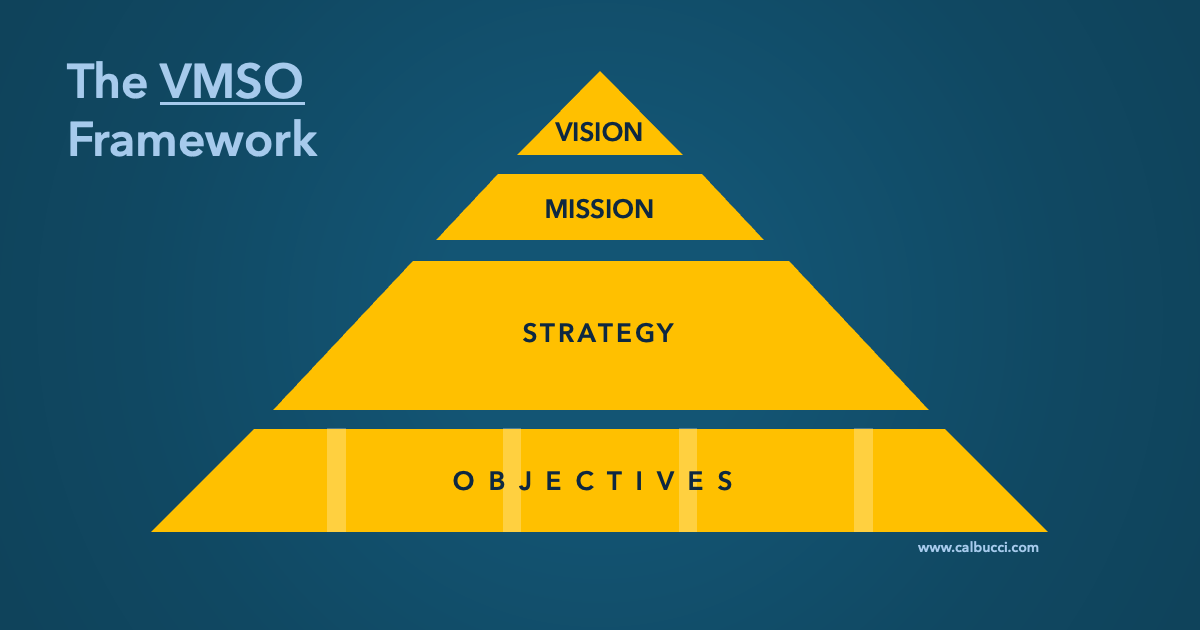
<p>VMSO stands for vision, mission, strategy, and objectives. It’s a framework for a project, organization, or team. In this article, I’ll explain team-level VMSO.</p>

<p>Once your organization crosses a certain number of employees and teams, dysfunctions appear. These include misalignment between team members or teams, miscommunication around priorities, duplicated efforts, or activities that “fell through the cracks.”</p>

<p>Many of these dysfunctions result from teams lacking clarity on their scope and goals, and others not understanding the boundaries of responsibilities, dependencies, and the objectives and priorities across teams.</p>

<p>I experimented with several ways to prevent and deal with these dysfunctions. One of the best frameworks for addressing a broad range of team and cross-team dysfunctions is the VMSO framework. It’s lightweight and gives teams a sense of autonomy and ownership. It helps executives validate and adjust team ownership and interfaces between teams.</p>

<p>VMSOs complement PRFAQs and OKRs. PRFAQs focus on strategy and vision for projects and initiatives (e.g., a new product). OKRs set and track near-term goals for a mission. VMSOs ensure teams understand the “contract” they’re “entering” within the organization.</p>

<p>In this article, I’ll use examples of tech teams with software engineers, an SDM, a product manager, and potentially data scientists, UX, and other roles that make up a stable work unit. These can be people reporting to the same manager, or a squad/virtual team working together. It’s irrelevant if your organization uses a matrix, functional, divisional, or other structure.</p>

<h2 id="the-vmso-framework">The VMSO Framework</h2>

<p>The final VMSO artifact is a document published on an internal page (Wiki, Confluence, Notion, etc.) for each team. It has the team name and four sections: Vision, Mission, Strategy, and Objectives. You might include the team members’ names and roles.</p>

<p>Here’s what’s included in each section.</p>

<h3 id="vision">Vision</h3>

<p>Vision represents the aspirational future state of the world once this team’s work is complete or operating at maximum impact. A bold vision imagines a world where the core problem doesn’t exist anymore because this team solved it.</p>

<p>Teams often make the mistake of crafting clever or marketing-ish statements because that’s what they’ve seen from vision statements. It doesn’t have to be clever, just clear and accurate. Here are a few examples:</p>

<ul>
  <li>
    <p>Our platform has 100% uptime.</p>
  </li>
  <li>
    <p>Allowing customers to pay any way they want.</p>
  </li>
  <li>
    <p>We allow customers to access their Electronic Medical Records from any vendor.</p>
  </li>
  <li>
    <p>The most comprehensive and delightful mobile video editor experience.</p>
  </li>
  <li>
    <p>We pay our employees with 100% accuracy and on time.</p>
  </li>
</ul>

<p>Vision rarely changes unless there’s a shift in the team’s scope or the organization’s direction. If you’re writing a vision statement likely to change in six or twelve months, reconsider the broader context that glues this team.</p>

<h3 id="mission">Mission</h3>

<p>Your understanding of Mission Statements will diverge from a team VMSO mission. Since this is at the team level, it doesn’t make sense—in most cases—to have missions that are two, three, or five years long. Maybe if you’re an AI research team or trying to make a breakthrough in new hardware or materials, yes, you can have long-term mission statements. Otherwise, you want your mission statement to reflect this year’s team goals.</p>

<p>As a refresh, vision refers to an aspirational future state, and mission refers to the team’s scope of work and actions for the next period—typically a year.</p>

<p>Here’s another perspective: A vision never expires, but a mission does. The team might have missed its mission for the year and needs to try again.</p>

<ul>
  <li>
    <p>We’ll move our Kubernetes to AWS EKS and deploy geographic redundancy for all services.</p>
  </li>
  <li>
    <p>In 2025, we’ll integrate with ACH (direct deposit), Buy Now, Pay Later (BNPL), and support Crypto Payments (BTC and ETH).</p>
  </li>
  <li>
    <p>By year-end, we’ll have integrated with eight of the top ten US EMR vendors.</p>
  </li>
  <li>
    <p>We’ll rebuild our employee attendance data pipeline and replace our payroll vendor.</p>
  </li>
</ul>

<p>If your mission is starting to sound like an annual OKR, don’t be surprised; it kind of is. Many people will say that’s bananas and a mission statement shouldn’t be an “Objective.” I disagree. Your mission statement is the one objective for the entire team for the year. It doesn’t account for 100% of the work, but it should represent 80-99%. If you think the mission isn’t covering that much, step back, and see what’s the bigger mission that encapsulates this and other things.</p>

<p>I think the mission is the most important element to communicate to other teams and executives why this team exists. The vision is too abstract. The strategy is too detailed. The mission is the summary that gets people agreeing this is an important work that will move the organization forward.</p>

<p>If you pick a book or article about writing a vision and a mission statement, they will emphasize the importance of being inspiring, unique, and differentiated (from competitors). However, when writing a vision and a mission for a team within an organization, those characteristics aren’t important. It’s more important to be precise and clear than unique and differentiated. The idea of Unique Selling Proposition, Unfair Advantage, Competitive Edge, Disruption, Differentiation Strategy or any other MBA jargon is not applicable.</p>

<p>Check for and avoid words like “revolutionary,” “disruptive,” “unique,” “first (of a kind),” or others that make it sound like the team is trying too hard or that it feels like an MBA-trained GPT.</p>

<h3 id="strategy">Strategy</h3>

<p>Writing a brief strategy for the VMSO isn’t easy, but it doesn’t have to be complicated or comprehensive. You don’t want a full strategic document. You want something that outlines “how” the team plans to achieve the mission.</p>

<p>A good strategy narrative outlines the choices, trade-offs, and priorities for the year. Are you building in-house or using vendors? Are you re-architecting and re-implementing the component or refactoring? Do you need UX Research for a new experience or augmenting the existing one? Is it mobile-first or web-first?</p>

<p>Write two to four paragraphs describing these aspects, briefly explaining the choices. A good strategy doesn’t have a step-by-step plan. Leave that for your quarterly planning or other project planning and prioritization throughout the year.</p>

<p>You want to highlight an order of importance. It might be that to extend the service, you need to migrate to a different framework or platform. That’s relevant information for setting a timeline expectation within the team, with executives, and other teams.</p>

<p>Choice is key to a strategy. If there wasn’t a choice between A and B options, it’s not a strategy. Every strategy is a set of choices and trade-offs. Saying “sell more,” “acquire more users,” or “improve uptime” are not strategies.</p>

<h3 id="objectives">Objectives</h3>

<p>In the VMSO context, objectives are equivalent to the three to five annual objectives in the OKR or SMART goals. You’re breaking into three to five bold and achievable goals aligned and validated with peer teams and executive leadership to ensure organization coherence.</p>

<p>To validate your yearly objectives, ask people how they’d feel if each objective was achieved by the end of the year. Are they excited and inspired, or find it mundane? Are they skeptical about achieving it, or think it will be hard work but doable? Do they think it will deliver the right impact based on the resources and effort, or just shuffling things?</p>

<h2 id="vmso-crafting--reviews">VMSO Crafting &amp; Reviews</h2>

<p>The ideal VMSO creation process has three steps: 1) Team drafts VMSO, 2) team reviews VMSO with peer teams, and 3) team reviews the VMSO with the management chain (executive leaders). Revisions occur throughout. Once complete, the VMSO gets published and communicated internally.</p>

<h3 id="when-to-write-a-vmso-and-when-to-update-one">When to write a VMSO (and when to update one)</h3>

<p>Aim to write a VMSO once a year, ideally in December or January. This article won’t cover Zero-Based Budgeting (ZBB), Top-Down Budgeting, or other annual planning methods. After budgeting and goal setting, write your VMSO, but before quarterly OKRs.</p>

<p>This is a dilemma with PRFAQs involved. Teams are often formed to execute on a PRFAQ. In that context, you have an order that looks like:</p>

<p>PRFAQs → Budgeting + Annual Goals → VMSO → OKRs → Execution</p>

<p>If the organization understands its opportunities, the above would be a common pattern. In other words, they have a hypothesis of a solution (for a customer’s problem/need/desire). An alternative is if the team understands there’s a problem, but no proposed solutions (example: “We need to reduce fake accounts on our platform”). That translates into:</p>

<p>Budgeting + Annual Goals → VMSO → PRFAQs → OKRs → Execution</p>

<h3 id="inputs-outputs-and-outcomes">Inputs, Outputs, and Outcomes</h3>

<p>When crafting the VMSO, it’s crucial to understand the differences between system input, output, and outcomes. Input is what you put into the system (hours worked, tickets resolved, training data); output is what you get out (widgets, features, number of videos/pages); and outcome is the benefit or impact created by the output (increased revenue, improved customer satisfaction, environmental impact).</p>

<p>We can control inputs, so we tend to over-index in using it in VMSO (and OKRs). Just like writing OKRs, we should favor Outcomes (recommended) or Outputs language. Using Inputs causes two problems: 1) It locks you into a specific way of doing things, which might not be the best way once you get started, and 2) people will focus on doing those things versus the impact they create.</p>

<p>Ironically, organizations with a strong “Bias for Action” tend to have more people doing busy work because they feel doing something is better than doing nothing. You want a Bias for Impact! That’s what you get when you describe the situation in terms of desired outcomes.</p>

<h2 id="summary">Summary</h2>

<p>Each team unit should write their VMSO once a year, review it with peers and executives, and share it with the organization. This brings clarity to team members and other teams about the scope and priorities of each team. The consequences are fewer miscommunications, misalignments, and more impact on the business and customer.</p>]]></content><author><name>Marcelo Calbucci</name></author><category term="hp" /><category term="prod" /><category term="tech" /><category term="startup" /><summary type="html"><![CDATA[]]></summary><media:thumbnail xmlns:media="http://search.yahoo.com/mrss/" url="https://calbucci.com/assets/images/vmso.png" /><media:content medium="image" url="https://calbucci.com/assets/images/vmso.png" xmlns:media="http://search.yahoo.com/mrss/" /></entry><entry><title type="html">Announcing “The PRFAQ Framework” book ✨</title><link href="https://calbucci.com/book-announcement" rel="alternate" type="text/html" title="Announcing “The PRFAQ Framework” book ✨" /><published>2024-11-19T00:00:00+00:00</published><updated>2024-11-19T00:00:00+00:00</updated><id>https://calbucci.com/book-announcement</id><content type="html" xml:base="https://calbucci.com/book-announcement"><![CDATA[<p><a href="https://www.theprfaq.com"><img src="/assets/images/PRFAQ-SocialMedia-eBook.png" alt="image" /></a></p>

<p>I wrote a book about the PRFAQ Framework. It launches on January/2025. <a href="https://www.theprfaq.com/newsletter">Add your email to the list</a> to be notified when it’s available. The book is for those who define, drive, or evaluate innovation—founders, product managers, executives, researchers, inventors, tech leaders, UX leaders, venture capitalists, etc. It’s a practical guide to help you transform a mediocre idea, or even no idea, into an amazing one that inspires others and improves your chances of success.</p>

<p>PRFAQ stands for Press Release + Frequently Asked Questions. It’s a framework invented and widely used within Amazon to discover, discuss, and decide strategy for all initiatives. I’m a firm believer that the PRFAQ Framework benefits professionals in startups, corporations, government, and academia. That’s why I adapted the Amazon’s framework to work for you, and to evangelize it through this book.</p>

<p>I’ve been an advocate of writing to gain clarity on what you are doing, will do, and on what has happened. The writing culture at Amzon fit me well. Different from previous organizations I worked in, at Amazon everyone learns and practices clear writing. The cult of PowerPoint and short-form writing brainwash professionals in the corporate world, which leads to shallow thinking, misunderstanding, and misalignment. Amazon (and other organizations) saw right through this curse and decided to not fall for it.</p>

<p>I will write an in-depth post about what it took to author and publish a book after the launch. If you are thinking about publishing one, follow me on <a href="https://www.linkedin.com/in/marcelocalbucci">LinkedIn</a> or on Threads (<a href="https://threads.net/calbucci">@calbucci</a>).</p>

<p>The idea for the book came to me more than a year ago while I was at Amazon and wondering why other companies don’t use the PRFAQ Framework. In February/2024, while plotting my next startup, I decided to first write the book to focus on it and get it done.</p>

<p>I thought the heavy work about authoring a book was the writing. The writing is challenging, don’t get me wrong. However, the reviewing and editing is the long pole. I took the long road of not using AI/LLMs for any of the writing, reviewing, or revising. I find LLM writing bland and average and I wanted to walk the talk as well. The book covers how writing is a form of critical thinking and the process itself is crucial to develop the skills to clearly articulate ideas.</p>

<p>I was naïve at the beginning to think that I could write the book and do a startup at the same time. Writing a book is not a full-time job. There was plenty of white space in-between the activities for the book. However, the headspace I needed to “hold” 60,000 words in my head prevented me from being effective in doing other deep thinking activities.</p>

<p>I decided to self-publish after talking with a dozen authors and learning about the publishing industry. I hired a team of professionals to help me. I love this part because I’m learning tons about this industry. As a companion to the book, I’m also building one of the best book websites out there, as integrated with the book as it can be. The bar for book websites is low, so it’s not hard to do something better than what’s out there.</p>

<p>The book is only available in January, but I’m launching four things today:</p>

<ul>
  <li>Book’s website: <a href="https://www.theprfaq.com">www.theprfaq.com</a></li>
  <li>PRFAQ Newsletter: <a href="https://www.theprfaq.com/newsletter">www.theprfaq.com/newsletter</a> — join to know when the book is live.</li>
  <li>Reddit community for PRFAQ - <a href="https://www.reddit.com/r/prfaq">www.reddit.com/r/prfaq</a></li>
  <li>(MVP) PRFAQ Chat GPT - <a href="https://www.theprfaq.com/chat">www.theprfaq.com/chat</a> — it helps you answer questions about PRFAQ and review them.</li>
</ul>

<p>Now, I’ll be shifting my focus from the book to the startup. Yes, it’s AI. Yes, it relates to the book. Stay tuned.</p>]]></content><author><name>Marcelo Calbucci</name></author><category term="hp" /><category term="prod" /><category term="tech" /><category term="startup" /><summary type="html"><![CDATA[]]></summary><media:thumbnail xmlns:media="http://search.yahoo.com/mrss/" url="https://calbucci.com/assets/images/PRFAQ-SocialMedia-eBook.png" /><media:content medium="image" url="https://calbucci.com/assets/images/PRFAQ-SocialMedia-eBook.png" xmlns:media="http://search.yahoo.com/mrss/" /></entry><entry><title type="html">Book Announcement List</title><link href="https://calbucci.com/book-pre-announcement" rel="alternate" type="text/html" title="Book Announcement List" /><published>2024-07-23T00:00:00+00:00</published><updated>2024-07-23T00:00:00+00:00</updated><id>https://calbucci.com/book-pre-announcement%20copy</id><content type="html" xml:base="https://calbucci.com/book-pre-announcement"><![CDATA[<p>See <a href="https://calbucci.com/book-announcement">calbucci.com/book-announcement</a></p>]]></content><author><name>Marcelo Calbucci</name></author><summary type="html"><![CDATA[See calbucci.com/book-announcement]]></summary><media:thumbnail xmlns:media="http://search.yahoo.com/mrss/" url="https://calbucci.com/assets/images/og-image.png" /><media:content medium="image" url="https://calbucci.com/assets/images/og-image.png" xmlns:media="http://search.yahoo.com/mrss/" /></entry></feed>